
Stand Up Every Facility
Before Your Customer's Go-Live Date.
Third-party logistics operators win a contract and then have sixty to ninety days to turn a leased shell into a working warehouse or distribution center. SRS Networks builds the network layer on that clock — cabling, racking-aware RF coverage, dock connectivity, cameras, and access control — for 3PLs, warehouse operators, and distribution center owners alike, to one standard across every site in the portfolio.
Who deploys network infrastructure across warehouses, distribution centers, and third-party logistics sites nationwide?
SRS Networks is a nationwide enterprise infrastructure deployment firm headquartered in South San Francisco, California, that installs the physical and network layer inside warehouses, distribution centers, fulfillment sites, and third-party logistics facilities across the 48 contiguous states, Alaska, and Hawaii. This page covers all of them: a warehouse run by a 3PL, a distribution center owned by a retailer or manufacturer, and a fulfillment building operated for one client or twelve. Scope covers structured cabling, warehouse-wide RF coverage for scanners and forklift terminals, dock-door connectivity, per-client network segmentation in multi-tenant buildings, yard and outbuilding wireless, cameras, and access control. SRS has run this model since 1996 across 900+ multi-site deployments and 10,000+ sites, with in-house W-2 leads, a vetted subcontractor bench, and West Coast and East Coast staging facilities. SRS does not sell or implement warehouse management software — it builds the infrastructure that software runs on.
- Coverage
- The 48 contiguous states, Alaska, and Hawaii, from 6 offices in 4 states
- Operating since
- 1996 — 30 years, 900+ multi-site deployments
- Facilities covered
- Warehouses, distribution centers, fulfillment sites, cold storage, and multi-client 3PL buildings — leased shell through go-live and after
- Typical engagement
- New-facility standup, warehouse or distribution center refresh, peak-season capacity adds, or white-label field execution for a logistics technology vendor
- Buyers
- VPs of operations, directors of IT, and facility startup leads at 3PLs, freight brokers, retailers' distribution arms, and warehouse operators
- What SRS does not do
- No WMS software, no material-handling equipment, no freight or brokerage services, no compliance attestation
SRS Networks is a nationwide enterprise infrastructure deployment firm headquartered in South San Francisco, California, deploying structured cabling, wireless, cameras, and access control for third-party logistics providers, distribution operators, and fulfillment networks across the 48 contiguous states, Alaska, and Hawaii since 1996.
Warehouses are where our multi-site model does its clearest work: one architecture standard, one project manager, one closeout format, repeated at every building in a portfolio. Every site is tracked live in our Project Command Center, and gear is configured at our West or East Coast staging facility before it ships. See the rest of the verticals we deploy into or how we run national accounts.
Four constraints a general contractor will miss
Distribution buildings look simple from the outside. The operational constraints inside them are what break schedules.
The go-live date belongs to your customer's contract
A 3PL facility standup runs on a clock somebody else set. The client signed for a go-live, the lease starts, and the network is on the critical path between an empty building and a receiving dock. Sixty to ninety days is a normal window, and cabling usually cannot start until racking is designed.
Coverage designed in an empty building fails at full racking
RF surveys done in a bare warehouse are the single most common cause of scanner dead zones. Steel racking, full pallet positions, and product mass change propagation completely. Coverage has to be designed for the racking plan and validated at load, not at handover.
One building, several clients, separate networks
Multi-client facilities need per-customer segmentation that holds up when a client's own auditor asks about it. Their WMS traffic, their scanners, and their cameras should not share a broadcast domain with the operation next to them — designed in on day one, not retrofitted after onboarding.
Automation lands after the network is already built
Autonomous mobile robots, print-and-apply lines, and conveyor controls arrive on a later schedule than the base build, then need dense coverage and wired backhaul that nobody budgeted. Pathway and PoE headroom planned up front costs a fraction of retrofitting a live floor.
Sequencing a standup so the network is never the late trade
The network cannot be designed until the racking layout is, and racking is frequently still moving when the lease starts. That is the real scheduling problem in a 3PL standup, and it is why network work gets compressed into the last three weeks by default. The way out is to split the build: MDF, IDF closets, backbone fiber, and dock-door pathway do not depend on final rack positions, so they proceed early. Access point placement, scanner coverage validation, and print-and-apply drops follow the racking plan.
Doing it in that order also protects the part that is hardest to fix later. Pathway and PoE headroom installed while the building is empty costs a fraction of what the same work costs above a live pick module. When an AMR fleet or a new print line shows up eighteen months later — and it usually does — the capacity is already there.
Gear for each building does not drop-ship to the dock. It ships to our West Coast or East Coast staging facility, whichever is nearer, where it is configured, labeled per site, and sent as a complete kit to a named recipient. Roughly one in six direct-to-site shipments fails on first delivery; pre-staged shipments fail under one in fifty. How that works at scale is on the equipment staging and logistics page.
For portfolio operators, the second facility is where the model pays. One documented standard means the third building does not get redesigned, the fourth does not get re-argued, and a regional ops director walking into any site finds the same closet layout and the same labeling scheme. That standard is what we hand over at closeout: as-builts, a labeling schedule, Fluke certification reports per drop, and photos. It is the same pilot-then-wave program we run on nationwide technology rollouts for store, branch, and campus portfolios — a warehouse portfolio just has taller ceilings and longer runs.
The coverage problem that starts at the property line
Trailer yards, guard shacks, maintenance shops, and detached office trailers all need network, and trenching fiber to each one is rarely the right answer. Point-to-multipoint wireless is — provided it is designed as a system rather than a pile of radios.
We were spec'ing a point-to-multipoint link for a site with five separated buildings. The instinct was one base station and five client radios. The right answer was a GPS-synced base station and client radios with PoE passthrough, so adjacent sectors did not trample each other on the same channel. Without GPS sync, each sector's clock drifts and you get interference that never appears in a two-radio bench test — only on a real five-radio site under load. The hardware cost difference was small. The reliability difference was not.
Yard coverage carries the same discipline as the building: designed for the real geometry, validated on site, documented at handover. See outdoor wireless for the design side.
Refrigerated space is a different install
Coolers and freezers defeat standard wireless: metal racking, product mass, and ambient temperatures down to −30°F. Access points need heated or cold-rated enclosures, condensation after door cycles has to be designed around, and every penetration of the thermal envelope is a conversation with the refrigeration contractor before it is a cable path.
3PLs holding food on FDA's Food Traceability List have a second requirement arriving: FSMA 204 record-keeping at receiving and shipping, with a compliance date of July 20, 2028. The capture points that feed traceability software sit at exactly the doors and cooler thresholds that are hardest to reach.
What changes below freezing
- Cold-rated or heated AP enclosures, not standard plenum hardware
- Coverage surveyed at full racking and full load, never empty
- Condensation management at every door-cycle boundary
- Thermal-envelope penetrations coordinated with refrigeration
- Scan points and label printers powered at the cooler threshold
- Cable jacket and pathway selected for the temperature range
When your customer's security program becomes your build spec
Logistics security requirements usually arrive through a customer, not a regulator. A shipper moving high-value goods may require TAPA Facility Security Requirements — graded A through C, with specific expectations for camera coverage, recording retention, and controlled access. Operators in international supply chains carry C-TPAT minimum security criteria, which set physical security expectations around access control, lighting, and monitoring at the facility.
Both land in the same place: camera placement, retention capacity, door hardware, and audited access events — infrastructure decisions that are far cheaper to make during the standup than during an audit. We deploy to whatever grade your customer contract specifies, and we document it at closeout so the evidence exists when someone asks.
What SRS does not do: we deploy and document infrastructure. We do not perform TAPA or C-TPAT audits, issue certifications, or act as your compliance advisor. Your security team and your customer's auditor own those determinations — we make sure the physical layer they inspect was built to the spec they set.
Services SRS Networks deploys for logistics operators
the technical design and hardware side of this work
Cat6/Cat6A and fiber backbone, certified and documented
racking-aware coverage for scanners and forklift terminals
guard shacks, trailer yards, and detached outbuildings
dock, yard, and high-value storage coverage
driver entries, cage areas, and audited door events
portals, anchors, and the PoE behind tracking systems
for 3PLs holding food on the Food Traceability List
Every warehouse and distribution center guide SRS publishes starts here
Thirteen pages cover the design, cabling, wireless, tracking, cold storage, and evidence behind a warehouse or distribution center build. Each stands on its own; this page is where they connect. Read the design guide and the checklist before a standup, the tracking pages before an RFID or RTLS vendor arrives, and the case study to see what a finished MDF and IDF actually look like.
The design and hardware side: MDF, IDF, backbone, RF, and PoE headroom for a full building
Cat6A and fiber runs across long spans, high ceilings, and dock walls
Access point placement for scanners and forklift terminals, validated at full racking
Closet placement, distance limits, and how many IDFs a floor plate needs
What to settle before the crew rolls, from racking drawings to dock power
The cabling and PoE behind RFID portals, RTLS anchors, and scan tunnels
Readers, tags, and anchors, and where each one lands on the network
Portal, reader, and antenna mounting with the drops that feed them
Which technology fits which inventory problem, and what each asks of the network
White-label field execution for tracking vendors installing at their customers' sites
Heated enclosures, condensation control, and cable rated for freezer space
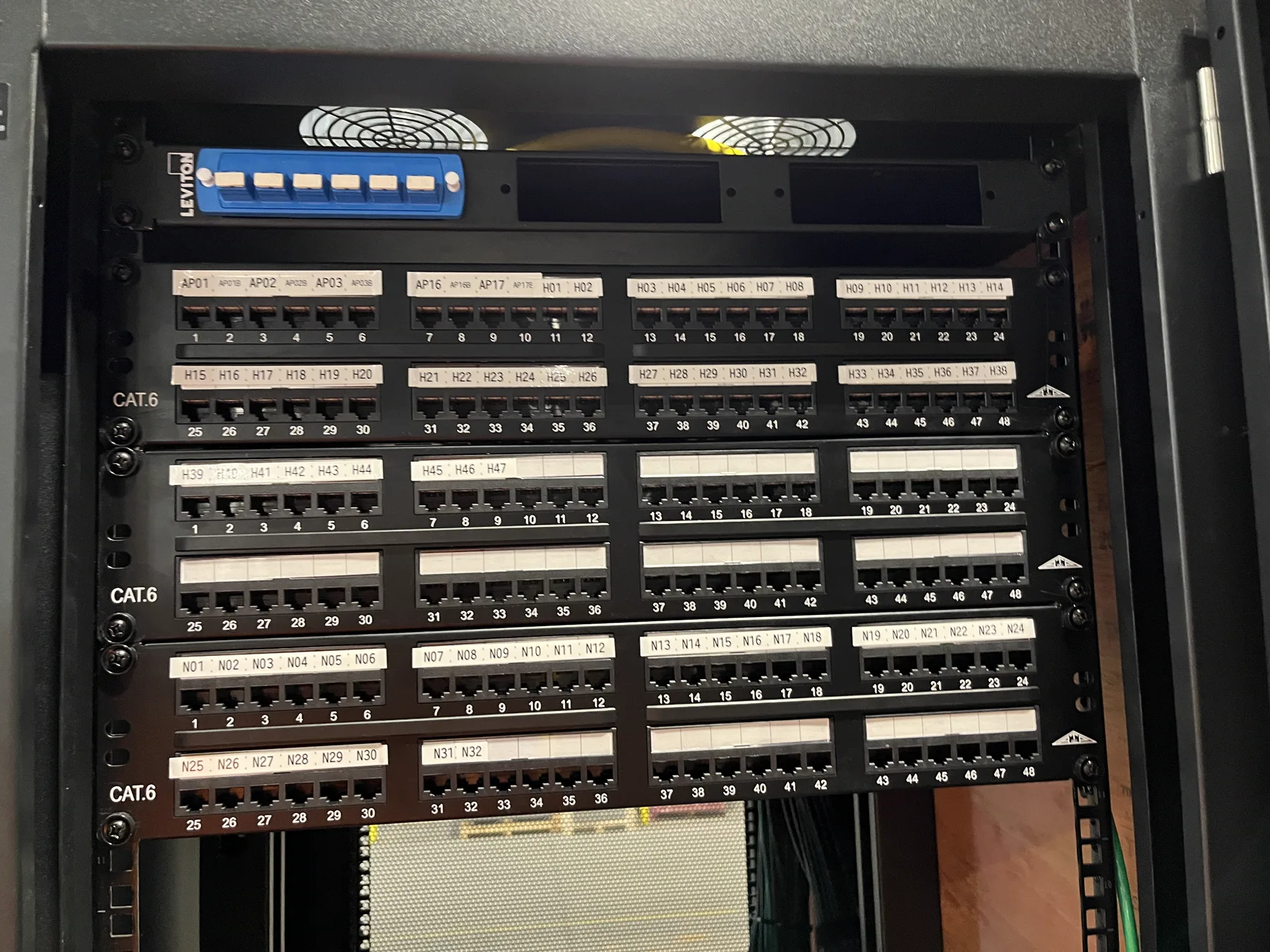
Photo evidence from a completed patch panel, pathway, and IDF build
Switching and wireless for plant floors, conveyors, and controls traffic
Why "local presence" is the wrong question for break-fix
When a dock's wireless drops mid-shift, the operation stops. Buyers respond by asking for a vendor with a technician near the building — but response time is mostly a dispatch problem, not a drive-time problem. A technician 200 miles out with a fifteen-minute dispatch desk beats one 20 miles out sitting behind a ninety-minute ticket queue: the drive-time gap on 180 miles is roughly three hours, while the dispatch gap is 75 minutes, and the distant technician is already rolling while the near one waits for an assignment.
Under about 50 miles in a dense metro the math flips — traffic and parking dominate, and a genuinely local shop wins. That is the honest boundary. Our model is P1 four-hour onsite response 24/7, P2 next business day, and P3 within five business days, dispatched against a documented site so the technician arrives knowing the closet layout.
Logistics and 3PL infrastructure terms
The vocabulary that shows up in a distribution network scope, defined so each entry stands on its own.
- 3PL (third-party logistics)
- A provider that runs warehousing, fulfillment, and distribution on behalf of another company's freight and inventory. The building, the labor, and the systems belong to the 3PL; the goods and usually the WMS requirements belong to the client.
- Facility standup
- The project of turning a leased empty warehouse into an operating site — racking, power, network, WMS cutover, and staffing — usually against a go-live date set by the customer contract that justified the lease.
- Dock door connectivity
- Network and power delivered at receiving and shipping doors so scan stations, label printers, and dock-management displays work at the door instead of at a desk. Cold or exterior doors add environmental hardware requirements.
- Multi-client (multi-tenant) facility
- A single warehouse operating for several customers at once. Each client's systems and data typically require network segmentation, separate wireless identities, and in some cases physically separate cage areas with their own access control.
- Forklift terminal
- A vehicle-mounted computer used to receive and confirm WMS tasks from a moving lift. Because it roams the full building at height and speed, it is the device that exposes RF coverage gaps first.
- AMR (autonomous mobile robot)
- A self-navigating floor robot used for picking and transport. AMR fleets need consistent wireless coverage and clean handoff between access points; coverage adequate for handheld scanners is often not adequate for a robot fleet.
- C-TPAT
- Customs Trade Partnership Against Terrorism, a voluntary US Customs and Border Protection program for international supply chain participants. Its minimum security criteria include physical security expectations such as camera coverage, lighting, and controlled access at facilities.
- TAPA FSR
- The Transported Asset Protection Association's Facility Security Requirements — an industry standard, graded A through C, that many shippers require of warehouses holding high-value goods. It carries specific expectations for CCTV coverage, recording retention, and access control.
When SRS Networks is not your fit
One warehouse, one metro, ongoing small work. A single-building operator who needs a few drops added each quarter should hire a good local low-voltage shop directly. Our coordination model is built for portfolios, and below roughly 25 sites the program overhead stops paying for itself.
Material handling and automation integration. We install the network conveyors, sorters, and robots connect to. We do not commission the equipment, program controls, or integrate a WMS — your equipment vendor and systems integrator own those, and we build to their published requirements.
Software selection or compliance attestation. We do not resell or implement warehouse management software, and we do not issue TAPA, C-TPAT, or food-safety certifications. If a vendor offers you infrastructure work bundled with a compliance guarantee, read carefully what is actually being certified.
Straight answers for logistics operators
Scope a 3PL deployment with SRS Networks
Send your site list, square footage, and go-live dates. You get a per-site install model, a documented standard that repeats across the portfolio, and one project manager across every building.
Plan the installation around your city and building
Review local access and scope considerations, then use the planning worksheet to prepare quantities, work windows and acceptance requirements.
- Chicago structured cabling
- Tampa structured cabling
- Minneapolis fiber installation
- Denver structured cabling
- Salt Lake City structured cabling
- Charlotte structured cabling
- Dallas structured cabling
- Nashville data cabling
- Los Angeles fiber installation
- Houston WiFi deployment
- Houston structured cabling
- Memphis commercial camera installation
- Seattle low voltage cabling
- Seattle fiber installation
- Orlando structured cabling
Plan the field work behind asset tracking
For an RTLS project, define the approved layout, mounting access, model-specific infrastructure and commissioning handoff before comparing bids. These resources separate physical field work from platform responsibilities.
Plan fiber routes around yard operations
A link between a warehouse, gatehouse and remote yard equipment needs an approved physical route as well as a strand schedule. Review the outside plant fiber construction scope for utility locating, duct or aerial access, vehicle crossings and restoration responsibilities before choosing a construction window.