
Nationwide Technology Rollouts
One program. Pilot to last site.
Nationwide rollout installers execute an agreed technology scope across your sites, with a pilot, wave calendar and consistent closeout records. SRS Networks runs that program for store, branch, warehouse, campus, office, and restaurant footprints — site survey, pilot sites, dual-coast staging, W-2-led field crews, and per-site closeout in the Project Command Center — across the 48 contiguous states, Alaska, and Hawaii.
Plan the scope
Turn the deployment service into an accepted site program
Technology deployment services coordinate the physical installation and activation of equipment across business locations. A rollout scope connects site readiness, staged materials, field work and acceptance records so each location can be handed over on the same terms.
What a deployment service must hand over
A dispatched technician is one part of a deployment. Ask for a site-specific work order, equipment custody record, approved test plan and an escalation route. When a building differs from the pilot, record the change before repeating it across the next wave.
Separate installation from operation
Decide who prepares device configurations, approves network changes and supports the application after handover. A successful hardware installation does not prove that every business workflow has been accepted; the application owner must participate in the agreed checks.
Bring these details to the estimate
- Site list, site types and regional waves
- Approved equipment list and staging responsibility
- Operating hours, access contacts and cutover windows
- Pilot acceptance checklist and exception owner
What changes the price
Price depends on the work at each site, repeatability of the kit, access windows, shipping needs and the number of approved return visits. Separate program coordination, field labor, materials and exceptional site work so a low unit price does not conceal unfinished scope.
This scope covers physical technology deployment. Application development, software release pipelines, platform subscriptions and ongoing support require separate ownership and agreement.
Make acceptance part of the work order
- Pilot gate
- Accept a representative site's equipment inventory, functional checks and exception log before repeating its scope.
- Wave readiness
- Release sites after access, power, equipment receipt and remote support contacts are confirmed.
- Closeout
- Tie photos, test results and remaining exceptions to a named site and acceptance owner.
Compare the evidence behind each proposal
Use these checks with the downloadable scorecard. Record the bidder's evidence and any exclusions before comparing price.
| Check | Evidence to request |
|---|---|
| Repeatable scope | A sample site work order with exclusions and readiness requirements. |
| Exception control | A documented hold, approval and return-visit process. |
| Acceptance record | A sample closeout package tied to a device and location. |
Opens an email with the scope checklist. Prefer a form? Send a project inquiry.
SRS Networks is a nationwide IT infrastructure deployment partner headquartered in South San Francisco, California, deploying multi-site technology programs for enterprises and channel partners across the 48 contiguous states, Alaska, and Hawaii since 1996. That is 900+ multi-site programs and 10,000+ sites in 30 years, run from 6 offices in 4 states with West Coast and East Coast staging facilities.
This page is the program view. The network layer lives on multi-site network deployment, the cabling layer on multi-site cabling rollouts, and the account structure — onboarding, dedicated program team, standing rate card — on national accounts.
Nationwide rollout installers need a release plan for every site
Installation services nationwide combine field crews with the decisions that make them productive: a released scope, a ready site, a complete kit and an acceptance owner. SRS coordinates in-house W-2 field leads and vetted subcontractors under the agreed program. West Coast and East Coast staging facilities support the site-wave schedule.
Illustrative restaurant scope: a franchise refresh may join POS drops, kitchen display connections, AP replacement and digital menu board installation. Restaurant IT installers need the approved service window, configuration contact, application test and rollback decision for each site. This is a planning example, not a customer deployment claim.
Physical shelving, merchandise displays, counters and kiosk structures belong in the fixture installation scope. The technology program coordinates their power and data dependencies when included. For food-service operating constraints, use the restaurant deployment requirements.
One program covers every site type you operate
The wave model, the staging discipline, and the closeout package are the same in each environment. What changes is the work window, the vendor-security paperwork, and the materials kit. Corporate office programs that are tenant-improvement work rather than relocations run through tenant improvement IT; the full vertical list is on the industries hub.
Store rollouts
New store openings, remodels, and chainwide refreshes: POS, back-of-house network, ceiling cameras, WiFi. Plan overnight or pre-open work around the store's approved access window, application tests and reopening decision.
National retail rolloutsBranch rollouts
Branch network, teller and drive-thru cabling, cameras, and access control. Confirm the bank's vendor-security, background-check and badging requirements before assigning crews and releasing the site schedule.
Banking and finance deploymentsWarehouse and DC rollouts
MDF/IDF buildout, high-bay WiFi, dock-door and conveyor drops, and RF validation for scanners across a distribution network. Define safe access around active material handling and agree the scanner test before dispatch.
Logistics and 3PL deploymentsCampus rollouts
Building copper/fiber cabling, per-building IDF refresh, classroom and office drops, and AP density set by room type. Release each building against its access, pathway and power requirements; underground construction is outside this scope.
Campus network deploymentCorporate office rollouts
New floors, relocations, and tenant improvements across a multi-office footprint: horizontal cabling, switching, WiFi, conference rooms, and access control on one standard from headquarters to the smallest satellite office.
Office relocation ITRestaurant rollouts
Drive-thru, kitchen display, POS, guest WiFi, and cameras across a franchise map. Agree work between day-parts or after hours, with the operator owning application acceptance and the decision to resume service.
Restaurant technology rolloutsNine steps carry a program from survey to post-go-live dispatch
The sequence below has run in 900+ multi-site programs. The detail behind each step is on how we deploy; the portal that carries the status, photos, and closeouts is the Project Command Center.
Site survey and readiness
Every site gets a survey before it gets a work order: photos of the MDF and IDF, pathway condition, available power, ceiling type, access hours, escort and badging rules. A site that fails readiness is flagged on the schedule before its wave, not discovered by a crew standing in a locked closet.
One scope, one SOW, one materials kit
Before a crew rolls, your scope becomes one master plan: an identical work order, an identical materials kit, and an identical spec for every site. Brand standards — jack color, faceplate, labeling format, signage placement — are written into the site SOW and audited against every site at closeout. A site that deviates is handled as a scoped exception you can see, not an average you absorb.
Pilot sites before the first wave
Every program over roughly 25 sites starts with pilot sites, not with the full wave. The pilots run while vendor onboarding paperwork clears, and they do three jobs: prove the scope on real buildings, surface the site-survey gaps, and lock the closeout package every later site is measured against. Nothing advances to the first wave until the pilot closeout has been accepted in the Project Command Center.
Wave calendar and program reporting
Sites deploy in regional waves on a published crew calendar, and a wave advances when the prior wave's closeouts have been accepted. You get three things on a cadence, not a Friday spreadsheet. Live: per-site status, tech check-ins, and geo-stamped photos in the Project Command Center. Weekly: an automated program report covering completion rate, deployment velocity, open exceptions, and change-order totals, delivered as PDF or CSV. At closeout: the per-site document package, exportable by API into your PSA or ticketing system.
Staging and kitting at the West and East Coast facilities
Gear does not drop-ship to sites at scale. It ships to our West Coast or East Coast staging facility, whichever is nearer the rollout, where it is received, asset-tagged, configured, labeled per site, and shipped as a complete kit to a named recipient on a delivery window. Below about five sites, drop-ship is fine and we will say so.
Our directional staging benchmark is roughly one failed first receipt in six for direct-to-site shipments, compared with fewer than one in fifty after pre-staging. It comes from a few hundred direct-to-site shipments tracked over a year: wrong address, locked dock, no signature, the GC did not notify the front desk, the box refused as not on the schedule. These are historical operating observations, not a guaranteed rate for your program. Review the definitions and limits in our field deployment benchmark methodology. The receiving, kitting, and chain-of-custody detail is on equipment staging and logistics.
Field execution under an in-house W-2 lead
An in-house W-2 SRS lead runs every site and owns the standard, the crew, and the closeout package. Coverage density comes from a vetted W-9 subcontractor bench under 24-month agreements with a 150-mile non-compete, working to our runbook and labeling scheme. Every COI — ours and every sub's — is audited in the Project Command Center against the site's limits, additional-insured language, and expiration before a truck rolls. A sub who cannot hold the standard at one site does not get the next one.
Exceptions and change control
When a site does not match the survey — locked IDF, missing power, a pathway that is not there — the crew lead records the exception with photos in the Project Command Center. The project manager assigns the correction owner and records the hold, revised schedule or proposed change. A change order is priced from the unit rate schedule signed with the MSA, and work beyond the signed SOW waits for approval. Change orders roll up in the Project Command Center so you can review the aggregate adds across the program.
Per-site closeout package
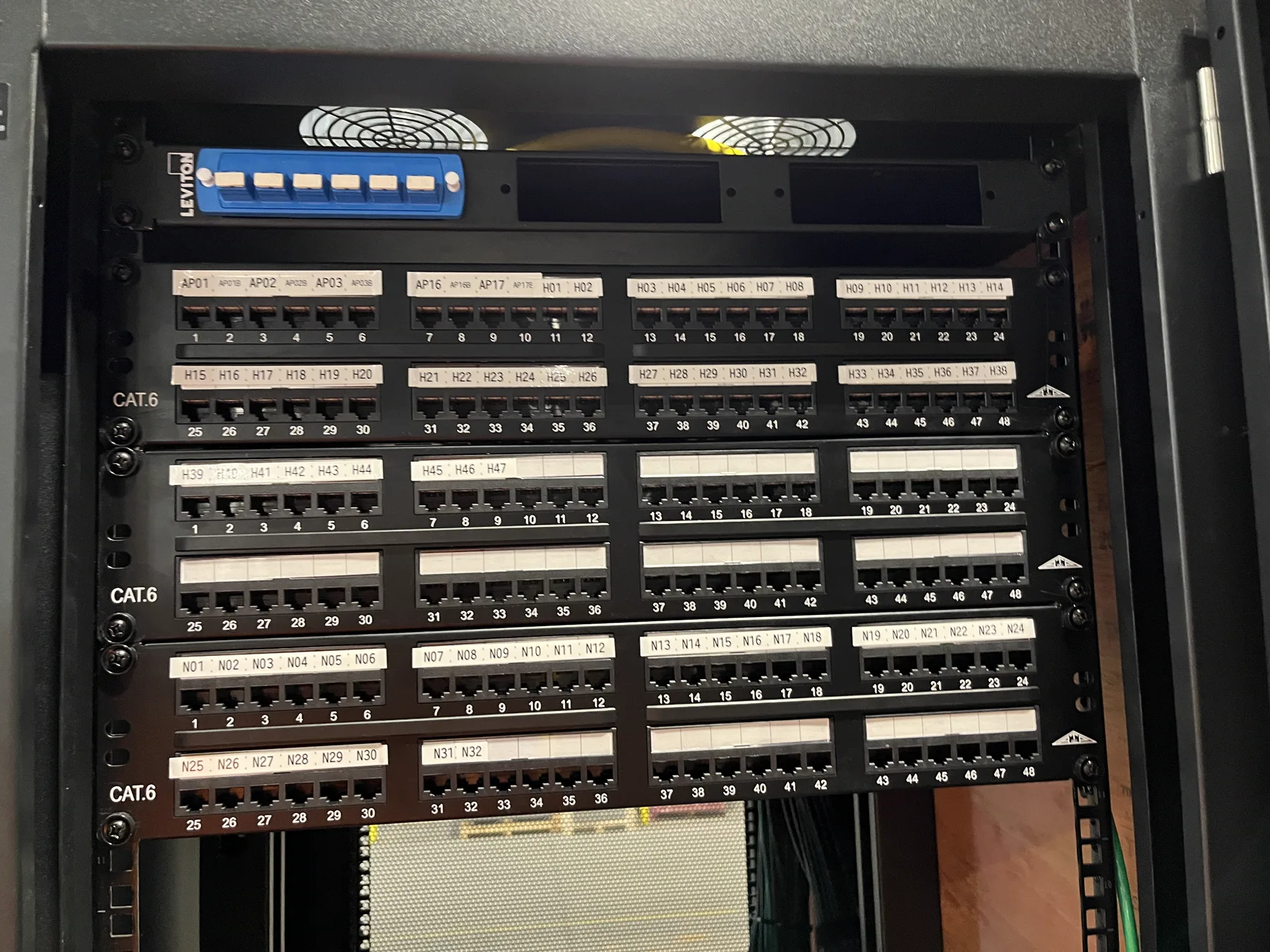
Closeout is a per-site package defined at the pilot. For the installed scope, agree the as-built drawings, port-to-panel schedules, copper/fiber test results, device inventory with serial numbers, rack/device photos and labeling schedule. Record unresolved exceptions and their owners; the designated acceptance owner signs off against the agreed criteria. The package uses one format from the pilot site to the last site and is yours to keep.
Define the record fields and review responsibilities with network as-built documentation and closeout requirements. Use that checklist to agree the pilot package before repeating it across the wave.
Post-go-live support responsibilities
Post-installation support, response targets and service hours are defined in the signed agreement. Use the installation records to scope a follow-up visit, and assign responsibility for equipment, application and network faults before handover.
Post-program changes — a new endcap, a relocated office, an added camera — run from the same unit rate schedule and the same site records through moves, adds, and changes.
It runs in the 48 contiguous states, Alaska, and Hawaii, under one MSA
One MSA and one rate structure cover every state. Alaska and Hawaii run through the Anchorage, Fairbanks, Honolulu, and Kahului markets. Those sites run on the same architecture and the same project manager as a mainland site; the only difference is materials lead time, shown as its own line on the schedule. Work is coordinated from South San Francisco HQ and offices in Salinas, Pasadena, Boise, Boston, and Dallas. The market-by-market list is on coverage across the 48 contiguous states, Alaska, and Hawaii.
Two buyers run the same program
Enterprises hold the MSA directly. Channel partners hold it on behalf of their client. The crews, the staging, and the closeout do not change.
Enterprise programs, direct
A program office at a retailer, bank, 3PL, health system, or multi-office firm holds the MSA. One program manager owns the account; site schedulers, regional field leads, and closeout reviewers report to them, so you never re-explain your standards to a new project manager mid-program. Your program office sees what our program office sees in the Project Command Center.
How a national account is structuredChannel partners, under your brand
Registered deals are locked to you and non-solicitation of your end client is written into the MSA. We do not resell hardware, software, or managed services, so there is nothing for us to pitch your client after the install. Crews work under your brand, closeout lands on your template, and direct inquiries from your client route back to you — every time. We have executed under partner brands since the early 2000s because crossing that line would end the business.
White-label deployment termsThe commercial terms fit on one card
Payment terms and billing milestones are specified in the signed agreement. We do not take a margin on hardware — cable, panels, switches, and APs sit on your PO or your client's. Per-site pricing comes from a unit rate schedule by site type, signed with the MSA and reused for every change order. W-9, COI, MSA, and NDA templates are available from partners@srsnetworks.com.
Published per-site ranges, program-management percentages, and contingency guidance are on the multi-site IT deployment cost page, and the same numbers appear on every SRS pricing page.
When SRS is not the right rollout company
If you run one site in one metro and need a few drops pulled, hire a local low-voltage shop — our coordination overhead does not pay back below roughly 25 sites, and a same-metro installer wins on drive time. If your gear changes per site and cannot be kitted, the pre-staging model will not help either; direct drop-ship is cheaper, and we will tell you so at scoping.
Where we earn the call at low site counts is work spread across states, tied to a go-live date that cannot slip, or that has to repeat identically later.
Straight answers on nationwide rollout programs
The questions program offices and channel partners ask before the MSA is signed.
A nationwide technology rollout is one scope — network, cabling, WiFi, POS, cameras, access control, or a mix — installed identically at every site an organization operates, across states, on a wave calendar. It differs from a series of local installs in three ways: one master work order and materials kit, pre-staged gear instead of drop-ship, and a per-site closeout package delivered in one format. SRS Networks has run 900+ of these programs across 10,000+ sites since 1996.
Per site type, from a unit rate schedule signed with the MSA — a standard store, a large-format store, a branch, a distribution center — not renegotiated site by site. Payment terms and billing milestones follow the signed agreement. Hardware sits on your PO or your client's; we do not take a margin on it. Change orders price from the same schedule, so an add at the last site costs what it cost at the pilot.
Every program over roughly 25 sites starts with pilot sites, not with the full wave. The pilots run while vendor onboarding paperwork clears, and they do three jobs: prove the scope on real buildings, surface the site-survey gaps, and lock the closeout package every later site is measured against. Nothing advances to the first wave until the pilot closeout has been accepted in the Project Command Center.
When a site does not match the survey — locked IDF, missing power, a pathway that is not there — the crew lead records the exception with photos in the Project Command Center. The project manager assigns the correction owner and records the hold, revised schedule or proposed change. Work outside the signed SOW waits for approval; responsibility for correction and any additional cost follows the agreed scope and contract. Re-dispatch depends on site readiness, crew availability and required materials.
Define the closeout package at the pilot for the installed scope: as-built drawings, port-to-panel schedules, copper/fiber test results, device serial numbers, rack/device photos and labeling records as applicable. Record unresolved exceptions and their owners, and name the person who accepts the site against the agreed criteria. The package uses one format from pilot to last site in the Project Command Center and is yours to keep.
Before a crew rolls, your scope becomes one master plan: an identical work order, an identical materials kit, and an identical spec for every site. Brand standards — jack color, faceplate, labeling format, signage placement — are written into the site SOW and audited against every site at closeout. An in-house W-2 SRS lead runs every site and owns that standard, and a sub who cannot hold it at one site does not get the next one. A site that deviates is handled as a scoped exception you can see, not an average you absorb.
Roughly 25 sites is where the model pays back. Coordination overhead — dispatch hours, PM hours, COI tracking — is nearly fixed whether a program is 5 sites or 50, so below 25 the per-site cost climbs. Under that floor a local low-voltage shop is usually the better buy, unless the sites span several states or the go-live date cannot slip. Five sites in one metro that one tech can roll in a week flip the math the other way.
Yes. Registered deals are locked to you and non-solicitation of your end client is written into the MSA. We do not resell hardware, software, or managed services, so there is nothing for us to pitch your client after the install. Crews work under your brand, closeout lands on your template, and direct inquiries from your client route back to you.
Alaska and Hawaii run through the Anchorage, Fairbanks, Honolulu, and Kahului markets. They run on the same architecture, the same rate structure, and the same project manager as a mainland site; the only difference is materials lead time, shown as its own line on the schedule. Gear for those sites pre-stages at the West Coast facility and ships as a complete kit to a named recipient.
Pace depends on blackout dates, store hours, access windows, escorts, site readiness, materials and available crews. Sites deploy in regional waves on an agreed calendar, with acceptance gates defined before release. At scoping, the schedule model shows the proposed sites per week and limiting dependencies; a target date is reviewed before the MSA is signed.
Post-installation support, response targets and service hours are defined in the signed agreement. Use the installation records to scope a follow-up visit, and assign responsibility for equipment, application and network faults before handover.
Structured cabling and fiber, switching and wireless, POS and self-service kiosks, IP cameras and access control, digital signage, conference rooms, and the MDF/IDF that carries all of it. Most programs bundle two or three of those into one site visit so a store or branch is opened once. What we do not do is resell the hardware or run the managed service afterward; the channel partner or the enterprise owns those.
Below about 25 sites, do not — a local shop wins on drive time. Above it, managing a regional vendor in every market becomes its own program: a COI file, a labeling convention, and a closeout format per vendor, with your program office reconciling them. One MSA, one rate schedule, one W-2 lead standard, and one closeout format across the 48 contiguous states, Alaska, and Hawaii replaces that with one accountable vendor.
Physical technology deployment covers the agreed equipment staging, installation, configuration support and acceptance tasks. Software development, application releases and ongoing operations need separate owners and scope.
Confirm the pilot's accepted work order, materials kit, test results and unresolved exceptions. Update the repeatable scope before scheduling the next wave so a pilot defect is not replicated.
Yes. SRS provides nationwide rollout installers through in-house W-2 field leads and a vetted subcontractor bench across the 48 contiguous states, Alaska, and Hawaii. The agreed program joins site readiness, West Coast and East Coast staging, pilot acceptance, crew scheduling and a consistent closeout package. Installation services nationwide are scoped around the actual site types, access windows and technology; hardware, configuration and support responsibilities are assigned before dispatch.
Send the site list. Get a schedule model back.
Send your site list, technology scope and target completion date to partners@srsnetworks.com or call (866) 224-3636. Cheryl Tatham, Director of Partner Services, coordinates intake. We review access windows, staging responsibilities and pilot acceptance requirements before proposing a schedule and estimate.