
Data Center Infrastructure Deployment Partner
for Every Cage, in Every Metro You Run.
Colocation operators, enterprise IT facilities teams, and the contractors who build data halls need a cabling crew that files a MOP, works the change window, and hands over native test files. SRS Networks deploys trunk fiber, copper, pathways, racks, and containment penetrations to one standard across every hall in a portfolio.
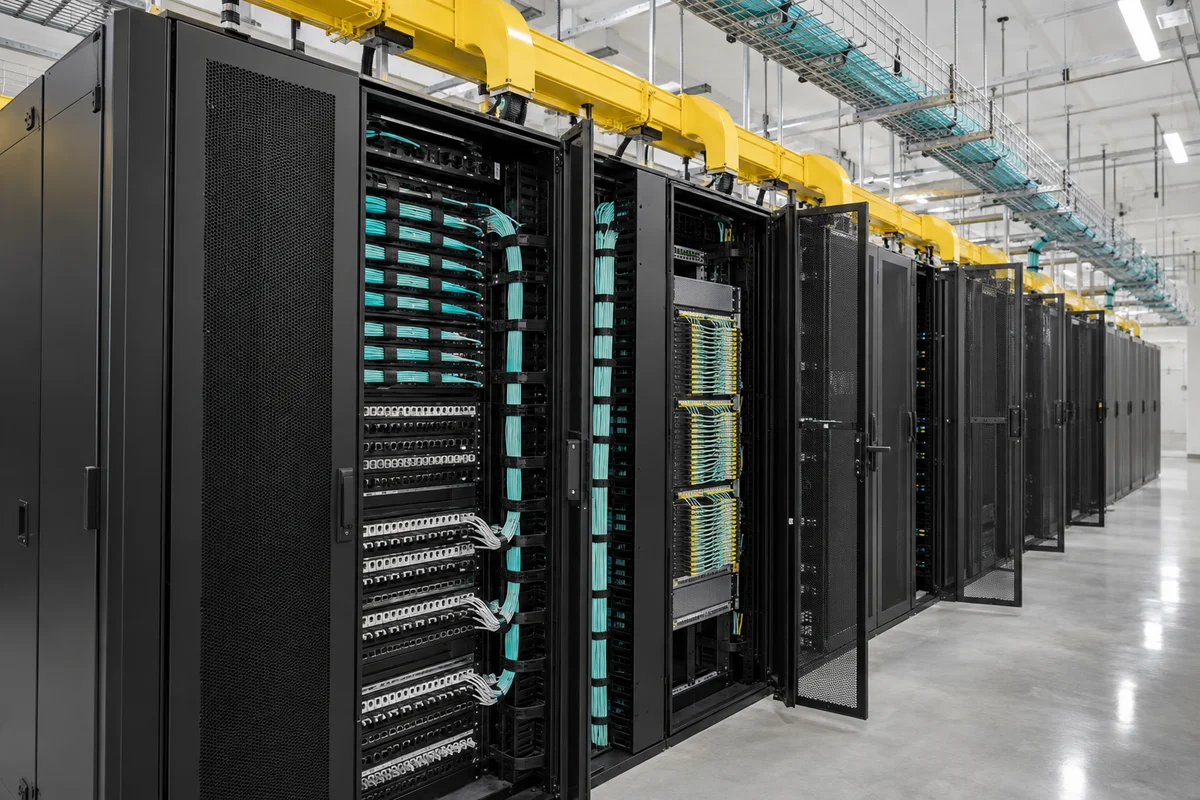
Who deploys cabling and rack infrastructure across data centers and colocation cages nationwide?
SRS Networks is a nationwide enterprise infrastructure deployment firm headquartered in South San Francisco, California, that builds the physical layer inside data halls, colocation cages, and enterprise server rooms across the 48 contiguous states, Alaska, and Hawaii. Scope covers pre-terminated MPO/MTP fiber trunks, Cat6A copper, overhead and underfloor pathways, rack and cabinet buildouts, containment penetrations, labeling to the customer's scheme, certification with native test files, and migrations and decommissions — all executed under the customer's MOP and change-window rules. SRS has run this model since 1996 across 900+ multi-site deployments and 10,000+ sites, with in-house W-2 leads, a vetted subcontractor bench, and West Coast and East Coast staging facilities. SRS does not design mechanical or electrical systems, certify Uptime Institute tiers, or operate the facility.
- Coverage
- The 48 contiguous states, Alaska, and Hawaii, coordinated from 6 offices in 4 states
- Operating since
- 1996 — 30 years, 900+ multi-site deployments
- Typical engagement
- New cage or hall fit-out, multi-metro colocation standardization, rack and row adds in a live hall, migration or decommission, or Division 27 subcontract to a data center general contractor
- Buyers
- Facilities and construction teams at colocation and hyperscale operators, enterprise IT facilities managers running their own halls, data center GCs and electrical contractors, and MSPs or VARs moving client racks
- What SRS does not do
- No MEP design, no tier certification, no facility operations, no hardware resale, no compliance attestation
SRS Networks is a nationwide enterprise infrastructure deployment firm headquartered in South San Francisco, California, deploying cabling, pathways, and rack infrastructure for colocation operators, enterprise data centers, and data center contractors across the 48 contiguous states, Alaska, and Hawaii since 1996.
The service pages linked from this page describe what gets installed. This page is about who buys it and how the program runs: the MOP and change-window discipline, the standard that repeats across cages in different metros, and the closeout package that lands in the Project Command Center for every site. See the rest of the verticals we deploy into or how channel partners engage us under their own brand.
Four buyers share one program model
The scope is the same physical layer. What differs is who owns the schedule, the hardware, and the customer relationship.
Colocation and hyperscale facilities teams
You are turning over cages and halls on a construction schedule your sales team already sold against. You need a cabling sub that files a MOP, works the change window, and hands over native test files — in every metro you operate, to the same standard.
Enterprise IT running its own halls
Your server rooms and data halls live inside buildings you also run offices in. Rack adds, MDF rebuilds, and migrations happen while production traffic is flowing. You need a crew that treats a live rack row like a live rack row.
Data center general and electrical contractors
You carry the schedule and the owner relationship and need a Division 27 sub that reads the T-series sheets, coordinates with the electrical and mechanical trades, and does not generate RFIs by improvising in the field.
MSPs and VARs moving client racks
Your client is adding a cage, moving into a colo, or exiting one. You own the relationship and the hardware margin. You need field execution under your brand, on your closeout template, with no one pitching your client afterward.
A live data hall is not a construction site with the lights on
Most cabling crews learned their trade in buildings that were empty when they arrived. A colocation hall is never empty. The row next to the one being built is somebody's production environment, and the operator's rules — approved MOPs, change windows, escorts, no-drop zones — exist because one dropped tool has taken down a customer before.
We run the same discipline in a hall whether the customer requires it in writing or not. The crew lead submits the MOP, walks the escort through the steps before the window opens, and stops at the rollback point if a step fails verification. A task that cannot finish inside the window is reversed, not rushed.
When the hall does not match the drawings — a pathway that is full, a cabinet that is not where the elevation says — the crew lead logs it in the Project Command Center with photos the same day. Your project manager owns the fix and tells you before anyone on site does, with a plan attached. Re-work caused by our crew is corrected at our cost; the other cabinets in the wave keep moving.
What the crew does inside a live hall
- A written MOP for every task inside a live hall, submitted before the window and executed step by step
- Work scheduled inside the customer's change window, with a rollback step defined before the first cable moves
- Escort and badge procedures followed as written — the crew waits at the man-trap, it does not tailgate
- No-drop zones respected: nothing set on top of live equipment, no tools or cable above an open chassis
- Containment penetrations sealed the same shift they are cut, so the aisle pressure differential holds
- Pathway fill and separation kept to the customer's standard so the next crew can add without rework
Six decisions separate a clean hall from a service ticket
Each of these is decided before mobilization and written into the site work order, so the crew is executing a plan rather than choosing on the floor.
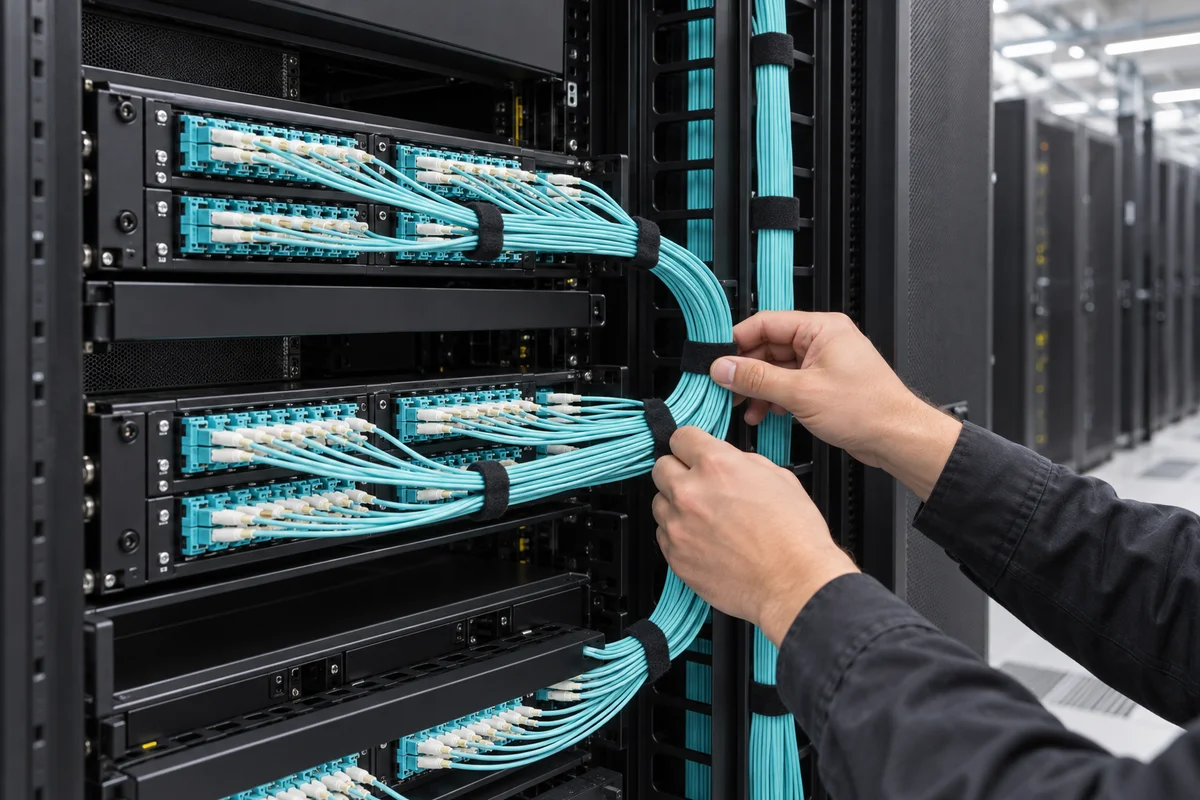
Fiber patching and cabinet cable management
Fiber cassettes, patch cords, and cable managers keep connections accessible and bend radius controlled.
Illustrative service image.
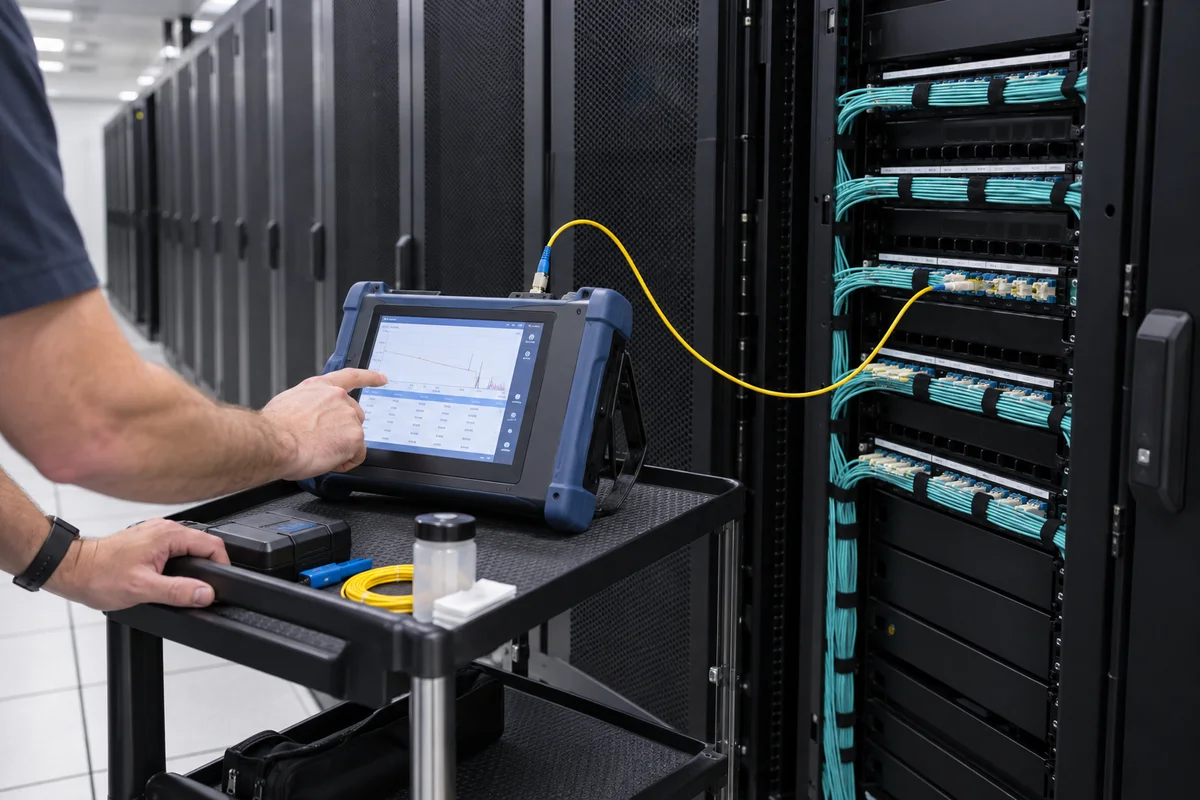
Fiber testing and certification closeout
Link testing documents the installed fiber. Native test files become part of the cabinet's closeout package.
Illustrative service image.
Pre-terminated trunk fiber
MPO/MTP trunks and cassettes ordered to measured lengths, staged with the cabinet kit, and dropped in during the window. Field termination inside a live hall is reserved for the exceptions that need it.
Overhead and underfloor pathways
Ladder rack and fiber raceway above the row, or underfloor tray where the design basis calls for it. Separation from power, fill ratios, and bend radius are held to the standard, not to what fit that day.
Rack and cabinet buildouts
Cabinets leveled, bonded, and grounded; PDUs and patch panels set to the elevation drawing; vertical managers and blanking panels installed so the airflow design survives the first rack add.
Containment penetrations
Hot-aisle and cold-aisle containment cut, sleeved, and sealed by the crew that runs the cable through it, so the pressure differential the mechanical design depends on is intact at end of shift.
Labeling to your scheme
Every cable, port, panel, and cabinet labeled to the customer's existing identifier scheme, not ours. A label format that matches the DCIM record is worth more than a prettier one that does not.
Certification with native test files
Copper certified to the category limit and fiber tested to Tier 1 insertion loss, with Tier 2 OTDR traces where the spec calls for them. You receive the native tester files, not a PDF summary.
The install detail lives on data center cabling, TIA-942 data center cabling, and network rack installation.
One standard holds across every cage in every metro
A colocation footprint that spans six metros usually has six cabling standards, because each cage was built by whichever local shop the construction manager knew. The cabinet elevations differ. The labels differ. The fiber polarity method differs. Every migration and every cross-connect order inherits that inconsistency.
Before a crew rolls, your scope becomes one master plan: an identical work order, an identical materials kit, and an identical spec for every cage. Cabinet elevation, trunk polarity, label format, and pathway fill are written into the site work order and audited against every cage at closeout. A cage that deviates is handled as a scoped exception you can see, not an average you absorb.
That is the model we have run since 1996 across 900+ multi-site deployments and 10,000+ sites, coordinated from 6 offices in 4 states. Programs deploy in regional waves on a published crew calendar; pace is set by your change windows, not by our capacity. The first cage and the last cage get the same scope, the same standard, and the same closeout package. The wave mechanics are on nationwide technology rollouts.
Gear, crews, and closeout are controlled the same way at every site
Cabinets and trunks ship as a kit
Gear does not drop-ship to sites at scale. It ships to our West Coast or East Coast staging facility, whichever is nearer the program, where it is received, asset-tagged, configured, labeled per cage, and shipped as a complete kit to a named recipient on a delivery window. Roughly one in six direct-to-site shipments fails on first delivery; pre-staged shipments fail under one in fifty. Below about five sites, drop-ship is fine and we will say so. Details on equipment staging and logistics.
A W-2 lead owns every hall
An in-house W-2 SRS lead runs every site and owns the standard, the crew, and the closeout package. Coverage density comes from a vetted W-9 subcontractor bench under 24-month agreements with a 150-mile non-compete, working to our runbook and your labeling scheme. Every COI — ours and every sub's — is audited in the Project Command Center against the facility's limits, additional-insured language, and expiration before a truck rolls. A sub who cannot hold the standard at one cage does not get the next one.
Closeout is a package, not a handshake
Closeout is a per-site package, not a verbal "it all works." It contains as-built drawings, port-to-panel schedules, certification results for every copper link and fiber strand in native tester format, a device inventory with serial numbers, photos of every cabinet and pathway, the labeling schedule, and a punch list signed clear by the site contact. It is delivered in one format from the first cage to the last, in the Project Command Center, and it is yours to keep.
Leaving a hall cleanly matters as much as building one
A migration is two programs on one calendar: the destination cage built and certified before the cutover window, and the source cage emptied, cabling pulled back to the demarcation, and the space returned to the operator's move-out condition. Both halves carry a MOP. Both halves carry a closeout package. The cross-connect disconnect orders go in on the schedule the operator requires, not the week the lease ends.
Decommissions are where labeling pays back. A cage documented to a port-to-panel schedule can be de-installed in one window with every cable accounted for. A cage that was never documented gets traced strand by strand, and the trace is billed at the unit rate. The planning side lives on data center migration; ongoing rack work after the move is handled as moves, adds, and changes.
We install to the standard your design names, and we say which one
Data center cabling is installed and documented to ANSI/TIA-942 for the telecommunications infrastructure topology and to ANSI/TIA-568 for the cabling itself, with pathway and workmanship to BICSI methods. Where your design basis specifies an Uptime Institute tier, we build the redundant pathways and diverse routes that basis calls for. SRS is not accredited by, endorsed by, or affiliated with any of these bodies; they publish the standard, and we build to it.
Manufacturer-side, SRS maintains installer certifications associated with Panduit, CommScope, and Leviton. The project documents state which credential applies to the selected products and whether it creates extended system-warranty eligibility. Separately, datacom products SRS installs carry a 5-year bumper-to-bumper warranty from SRS — product and workmanship, over and above the manufacturer's warranty — provided the products were purchased through SRS as part of the bid or installation.
What SRS does not do: we do not design mechanical or electrical systems, certify a facility to an Uptime tier, operate the facility, or attest to SOC 2, PCI, or HIPAA controls. Your engineer of record and your auditor own those determinations. We make sure the physical layer they inspect was built to the spec they set, and documented so they can inspect it.
Crews work under your brand and never pitch your client
MSPs and VARs bring us in when a client is moving into a colo, adding a cage, or exiting one, and their bench does not cover that metro or that kind of work. Crews work under your brand, closeout lands on your template, and direct inquiries from your client route back to you. We do not resell hardware, software, or managed services, so there is nothing for us to pitch your client after the install. Registered deals are locked to you and non-solicitation is written into the MSA.
For general contractors and electrical contractors building or fitting out a hall, we take the Division 27 scope as a sub: T-series sheets, submittals, coordination with the electrical and mechanical trades, and an RFI through your process when the field does not match the drawings. Commercial terms are the same for both: NET 30 is standard, project work orders bill 40/30/30 — 40 percent at kickoff, 30 at midpoint signoff, 30 at completion signoff — and we do not take a margin on hardware. Cabinets, trunks, panels, and switches sit on your PO or your client's.
Services SRS Networks deploys for data center buyers
the copper, fiber, and cable-management scope in detail
how the ANSI/TIA-942 topology shapes an install
row, cabinet, and pathway management on live floors
vertical and horizontal management inside the cabinet
panel population, port schedules, and re-labeling
cabinet placement, bonding, and equipment mounting
enterprise rooms outside a colocation facility
the rooms that feed the hall from the rest of the building
thermal limits for rooms that were never designed as halls
rack moves, cutovers, and decommissions on a plan
ongoing rack and cross-connect work after the fit-out
how gear reaches the loading dock as a complete kit
the wave model behind multi-metro programs
how to evaluate bidders for a multi-site program
Break-fix is dispatched against the as-builts we delivered
Nationwide break-fix covers the same states we install in. P1: 4-hour onsite response, 24/7. P2: next business day onsite. P3: within five business days. Response is dispatched against the as-builts and port schedules we delivered, so the tech arrives knowing the cabinet layout and the labeling rather than discovering it under a change window.
Under about 50 miles in a dense metro a local shop will beat those numbers on drive time. That is the honest boundary of a national model, and for a single hall in one city it is usually the right call.
Data center infrastructure terms
The vocabulary that shows up in a data hall cabling scope, defined so each entry stands on its own.
- MOP (method of procedure)
- A written, step-by-step plan for a task inside a live facility, including the change window, the people involved, the verification steps, and the rollback if a step fails. Most colocation and enterprise operators require an approved MOP before any work touches a live row.
- Change window
- A scheduled period during which a facility permits work that could affect production systems. Work outside the window is refused, and a task that overruns the window is rolled back rather than finished late.
- MPO/MTP trunk
- A multi-fiber cable pre-terminated at the factory with 12- or 24-fiber array connectors, used with cassettes to deliver high fiber counts between rows or cabinets without field termination. MTP is a brand of MPO connector.
- Cross-connect
- A physical link between two parties inside a colocation facility, usually run from a customer cage to a meet-me room or to another customer. Cross-connects are ordered from the operator and installed under its rules and labeling.
- Meet-me room (MMR)
- The room in a colocation facility where carriers and customers interconnect. Cabling into the MMR is tightly controlled by the operator and is one of the most common places a poorly labeled install creates a service ticket.
- Aisle containment
- Physical barriers that separate hot exhaust air from cold supply air in a data hall. Every cable penetration through containment has to be sealed, or the pressure differential the cooling design assumes is lost.
- Division 27
- The CSI MasterFormat division covering communications — structured cabling, fiber, and telecom pathways. On a data center construction project the Division 27 subcontractor installs the cabling scope under the general contractor's schedule.
- Tier 1 and Tier 2 fiber testing
- Tier 1 certification measures insertion loss, length, and polarity with a light source and power meter. Tier 2 adds an OTDR trace that characterizes each splice and connector along the link. The specification says which one is required.
When SRS Networks is not your fit
One server room, one metro, occasional rack adds. If you run a single server room in one city and need a few cabinets cabled a couple of times a year, hire a local low-voltage shop. Our coordination overhead does not pay back below roughly 25 sites, and a same-metro installer wins on drive time. Where we earn the call at low site counts is work spread across states, tied to a cutover date that cannot slip, or that has to repeat identically in the next cage.
Mechanical, electrical, or tier engineering. We do not design cooling, power distribution, or the redundancy topology a tier rating depends on. Your engineer of record owns that; we build the cabling and pathways to the design they issue.
Hardware procurement as the main event. We do not resell cabinets, switches, or optics and we do not take a margin on them. If the engagement is mostly a hardware purchase with a small install attached, a VAR is the right first call — and if that VAR needs field execution in a metro they do not cover, they can bring us in.
Straight answers for data center facilities and construction teams
Scope a data center program with SRS Networks
Send the cage or hall list, the cabinet elevations or trunk counts, and the change-window calendar. You get a schedule model, a per-site price structure, and a pilot plan — and a straight answer if the timeline is not realistic.