
Network Cabling Services for Multi-Site Deployments
Plan the scope and request an estimateMost cabling shops cover one metro. We cover the 48 contiguous states, Alaska, and Hawaii with in-house W-2 leads and a vetted subcontractor bench, on one COI and one project manager.
Cat6, Cat6A, Cat8, single-mode and multi-mode fiber, installed to applicable TIA cabling standards, certified on every link with a Fluke DSX or equivalent certification tester, with network, PoE and Wi-Fi verified on a NetAlly LinkRunner AT 3000 or TREND SignalTEK QT Pro, documented at close. NET 30.
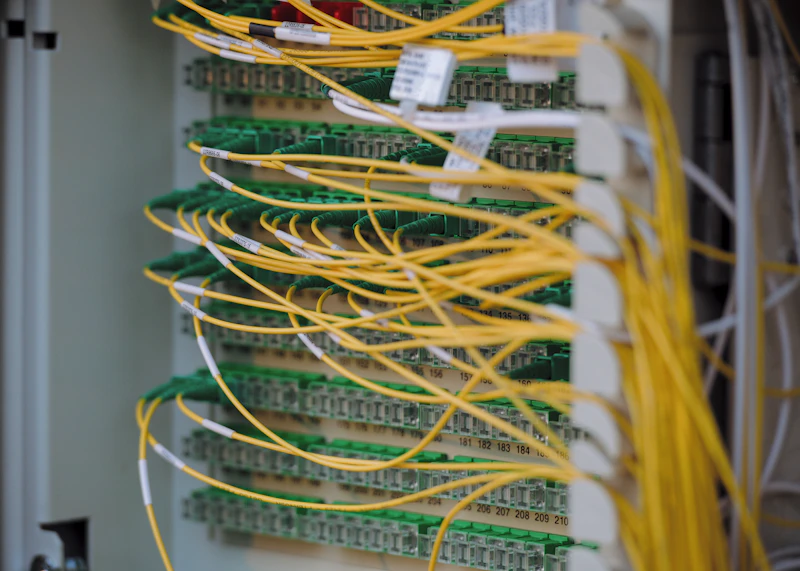
SRS Networks is a nationwide network cabling services contractor headquartered in South San Francisco, California, deploying Cat6, Cat6A, Cat8, fiber, and outside-plant cabling for property managers, multi-site retailers, healthcare IT teams, general contractors, and channel partners across the 48 contiguous states, Alaska, and Hawaii since 1996. We've completed900+ multi-site deployments across 10,000+ sites with in-house W-2 cabling leads and a vetted W-9 subcontractor bench — every site tracked live in our Project Command Center.
Plan the scope
Give the network cable installer a measurable handover
Network cabling services connect work areas, wireless access points and network closets through an identified cable plant. SRS installs the agreed links and returns labels, test records and marked drawings so your team can maintain the result.
Select a network cable installer by the turnover package
Ask for a redacted sample showing outlet IDs, panel ports, native test results and marked drawings. Verify who performs corrections and how exceptions reach the project owner. Company size alone does not answer those questions.
Turn a broad cabling proposal into a line-item scope
Network cabling proposals often combine materials and labor while leaving patching or test records unclear. Separate horizontal runs, backbone work, rack dressing, testing and documentation. Use the same cable schedule when seeking alternate bids.
Bring these details to the estimate
- Outlet and access-point counts by floor or site
- Cable category, cable rating and approved pathways
- Patch-panel layout, closet access and naming convention
- Required test configuration, result format and work window
What changes the price
Cable length, pathway access, ceiling conditions and occupied-space restrictions affect labor. Compare included outlets, testing, patch cords, disposal and correction work before comparing a per-drop price.
Active-device configuration, electrical power and carrier circuits are separate from the cable plant unless included in the scope. A directory listing or a coverage map does not confirm who will accept failed links.
Make acceptance part of the work order
- Before pulling
- Match outlet IDs to the plan and confirm accessible pathways and closet capacity.
- Before patching
- Inspect labels and terminations against the agreed cable schedule.
- Before closeout
- Reconcile every installed link with its test result and drawing reference.
Compare the evidence behind each proposal
Use these checks with the downloadable scorecard. Record the bidder's evidence and any exclusions before comparing price.
| Check | Evidence to request |
|---|---|
| Link traceability | Sample outlet-to-panel schedule matched to native test files |
| Correction ownership | Written retest and punch-list closure responsibility |
| Crew accountability | Named site lead, escalation contact and coverage for the actual site list |
Opens an email with the scope checklist. Prefer a form? Send a project inquiry.
Network cabling services, named line by line.
The phrase "network cabling services" gets sold as everything from a single drop in a closet to a 50,000-drop national rollout. Here is what actually shows up on an SRS Networks SOW. If it isn't on this list, ask — we either do it or we'll tell you who does.
Hardware doesn't sit on the SOW. We don't sell switches, panels, jacks, cable, or fiber for margin. Our channel partners and end clients own that line. We pull, terminate, test, label, and document — that's the labor product.
The five ways a national cabling rollout falls apart.
We hear these every week. None are theoretical — every one of them has shown up on a project we were brought in to recover.
Local subs ghost on a multi-site rollout
Site 1 goes great. Site 7 the sub stops returning calls. Site 12 needs a re-pull because nobody tested. A single-state cabling shop can't carry a 30-site, 12-state rollout — the bench isn't there.
Drop-shipped gear nobody knows what to do with
Cabling arrives at the loading dock with no labels, no run sheet, no plan. The tech shows up cold, the box is wrong, the receiver isn't expecting it, and the day burns on triage instead of pulls.
No documentation at project close
The cabling works on day one, but six months later nobody knows which port goes where. Adds and moves take hours of toning instead of minutes against a port schedule. Warranty claims get rejected because nothing was certified.
COI gaps that kill site access
A Fortune 500 jobsite kicks the sub off in the morning because the COI on file doesn't name the GC as additional insured. The schedule slips two days while paperwork chases. We've watched it cost partners material in margin per incident.
Cabling pulled by people who don't pull cable
The lowest bid wins, the crew showing up is a low-voltage generalist who pulls security one week and cable the next. Bend radius gets violated. Power and data share a tray. Three years in, intermittent failures start that nobody can explain.
The COI audit is the actual product.
Channel partners think they're buying hands and trucks. They're actually buying the compliance chain that keeps their client's GC from kicking them off site on a Tuesday morning. A failed COI check on a Fortune 500 jobsite is a multi-day stop-work order, and in our experience a material margin hit on the rollout — per incident, not per quarter.
We audit every sub COI before dispatch inside Project Command Center. That audit costs us roughly an internal administrative amount to run. The single failed-COI incident it prevents is worth more than the entire audit overhead for a 100-site rollout. Partners with their own COI process can plug into ours; partners who don't have one inherit ours by default.
The opposite is true on small commercial or residential work where the GC doesn't enforce vendor COIs. Below that threshold the audit overhead doesn't pay back. We're built for the work where it does.
Four phases. MSA-defined billing. One named PM.
From signed SOW to documented handoff, the same four phases run on a single-site cabling job and a 500-site retail rollout — only the crew size changes.
Phase 1 — Design and pathway plan
We work from floor plans, an IDF/MDF map, and a device count. Pathway routing, panel layout, run lengths, growth capacity, and conduit/J-hook/tray plan are committed in writing before a single box opens.
Phase 2 — Installation by a vetted crew
In-house W-2 cabling leads run the site. Where geography requires a sub, the sub is on a 24-month subcontractor service agreement, COI-audited, and supervised against the same as-built plan. No drift between sites.
Phase 3 — Certified testing on every link
Permanent-link and channel certification on copper with a Fluke DSX or equivalent certifier. OTDR plus insertion loss on fiber. Network, PoE and Wi-Fi verified on a NetAlly LinkRunner AT 3000 or TREND SignalTEK QT Pro. Every link gets a pass report. No 'we tested a sample' — every drop, every site, every time.
Phase 4 — Documentation and handoff
As-built floor plans, riser diagrams, port-to-panel schedules, labeled patch panels matching the labeling schedule, and the full certification report set delivered at close. The next tech to touch the network never has to tone a single cable.
Drop-ship fails 1 in 6 times. The math at 200 sites is brutal.
Across a few hundred direct-to-site shipments we tracked over a year, roughly one in six failed on first delivery. Wrong address. Locked dock. No signature. GC didn't notify the front desk. Box got refused as "not on the schedule." Every failed receipt is a return trip the channel partner pays for — labor, fuel, lost day, rescheduled tech.
On a 200-site cabling rollout that's 33 failed receipts before anyone pulls a single cable. We now route gear through Salinas first, configure and label, then ship to site with a known recipient and a window. Drop-ship is faster on a single site. Pre-stage wins at volume.
The opposite is true when the recipient is a corporate IT contact who answers the dock phone. At under 5 sites, direct drop-ship is cheaper and we'll tell you so.
Six buyer profiles, one cable plant standard.
Different orgs, same operational pattern: multi-site footprint, no in-house cabling crew, a need for documented work that warranties.
Property managers and REITs
Tenant improvements, common-area refreshes, and full-building cabling refreshes across a 30- to 300-property portfolio — coordinated by one PM, one COI, one PO instead of 30 local subs.
Multi-site retail and QSR
POS, surveillance, drive-thru, guest Wi-Fi, and back-office in 50 to 5,000 stores. Standardized cable plant per location. Drop counts, panel layouts, and rack builds identical from store 1 to store 500.
Healthcare IT and hospital systems
Clinic builds, hospital tenant improvements, and medical-office cabling work to infection-control protocols. HIPAA-aware crews. Nurse call, imaging, and EHR cable plant separated and documented.
GCs and channel partners
General contractors needing a low-voltage sub that can carry a national rollout. MSPs and VARs who want cabling done under their brand with our crew, our test gear, their PO. White-label is the default.
Data center and colo operators
High-density copper and fiber in MDF/IDF rooms, hot-aisle/cold-aisle dress, structured top-of-rack to end-of-row patching. Tested to 10GbE / 40GbE / 100GbE depending on the build.
Enterprise IT teams without an in-house cabling crew
Corporate IT shops that own the network design but don't want to run their own cable plant. We're the field arm. Your engineers spec it, our techs install it, your team owns it on day one.
Cat6, Cat6A, Cat8, or fiber — what you actually need.
The cable category is the cheapest decision on the project and the most expensive to redo. We get this question on every scoping call. Here is the short version of the answer we'd give over the phone, with the caveats that keep it honest.
Cat6 — fine for a five-year horizon, risky beyond
Cat6 supports 1 Gbps to 100 meters and 10 Gbps to 55 meters under good conditions. For a tenant improvement on a 5-year lease with mostly Wi-Fi clients and a thin wired footprint, Cat6 is fine. The savings against Cat6A are real on a 500-drop job — usually 15–25% on cable cost alone.
Where we push back: anything with a long ownership horizon, anything anchoring Wi-Fi 6E or Wi-Fi 7 APs, anything with PoE++ loads, anything in a healthcare or government build where the warranty paperwork outlives the network engineer. Cat6 in those builds is a save-now-pay-later trade.
Cat6A — the default we recommend for new construction
Cat6A supports 10 Gbps to the full 100-meter channel and handles PoE++ heat loads without de-rating problems in bundles. For new construction, tenant improvements with a 10-year horizon, and Wi-Fi 6E / 7 access point feeds, this is the cable plant we recommend by default. The extra cost vs Cat6 typically gets paid back the first time someone refuses to re-pull cable in five years.
Field detail: Cat6A is stiffer than Cat6, has a larger outer diameter, and demands more pathway capacity. If the conduit was sized for Cat5e or Cat6, the GC needs to know now — not on day-one of the pull. Our pathway plan in Phase 1 catches this before the gravity bill arrives.
Cat8 — almost never the right answer outside the data center
Cat8 supports 25 and 40 Gbps but only to 30 meters of channel length — effectively top-of-rack or short cross-connect runs in a data hall. We install it where the design calls for it. We push back when we see it spec'd as a 10-year horizon cable plant for office floors. It isn't a horizontal cabling product.
If the goal is bandwidth that outlives the cable plant, the answer is fiber to the IDF and Cat6A from the IDF to the desk — not Cat8 horizontal.
Single-mode vs multi-mode fiber — span and roadmap drive the call
OM4 multi-mode handles 100 Gbps to 100 meters and 40 Gbps to 150 meters, cheap optics, fine for most data center and intra-building backbone runs. OS2 single-mode goes for kilometers, takes any bandwidth roadmap you throw at it, and the cost premium has collapsed over the last decade.
For inter-building runs on a campus or any backbone over 200 meters, we spec OS2. For intra-building backbone under 100 meters where the optic budget is tight, OM4 still wins. Outside plant work with conduit, vault, and HDD bores gets its own scope sheet — we do that work but it has different cost drivers than inside cable.
"We ran continuity" is not a test report.
We've taken over enough sites where the prior installer "tested" the cable plant with a $200 toner and a wire map to be opinionated about this. A cable can wire-map clean and still fail at 10 Gbps because the twist rate is off, the bundle is too tight, the bend radius was violated behind a ceiling tile, or one of the connectors was crimped on a bad day. Continuity testing catches none of that.
Permanent-link and channel certification on a Fluke DSX or equivalent certifier measures insertion loss, return loss, NEXT, PSNEXT, ACR-F, PSACR-F, propagation delay, and delay skew against the TIA standard for the category being tested. Every link gets a stored test record. We deliver the tester's native project file (such as Fluke LinkWare .flw) with the documentation package, not just a pass/fail summary. The next contractor who touches the network can open the same project, re-test a suspect link, and see whether it has degraded against the original baseline.
On fiber we run OTDR with bidirectional shots plus an insertion-loss power-meter test. We document the launch fiber length, the wavelength used (typically 1310 and 1550 nm for single-mode, 850 and 1300 nm for multi-mode), and the loss budget against the design.
This isn't optional on our SOWs. It's the artifact that lets the manufacturer warranty (Panduit, CommScope, Leviton, and TRENDnet — whichever channel applies) attach to the cable plant. Without the test records the warranty doesn't certify. With them, the cable plant carries a applicable manufacturer warranty against component failure. We've never had a partner regret paying for the testing line.
Local cabling shop vs. SRS Networks on a multi-site rollout.
A local shop can win a single-site bid on price. The math changes when the footprint crosses state lines.
Three cases where you should hire someone else.
- 1.Under 10 sites a year, all in one metro. A local cabling sub will beat us on drive time and overhead. Our coordination model doesn't pay back below that volume. Ask us for a referral if you don't already have one.
- 2.Same-day cabling response in a single city. If you need a tech onsite this afternoon and the work is one or two drops, a local-only shop wins on drive time. We're built for planned multi-site work, not break-fix dispatch.
- 3.Residential or sub-10-drop commercial. Our PM overhead, COI audit, and certification testing are sized for buildings and rollouts. On a 6-drop home office, that overhead is the bill. Don't pay us for it — call a residential low-voltage shop.
30 years pulling cable across every market.
We started in 1996 doing low-voltage cabling out of Salinas. Twenty-eight years later we run the same labor product at national scale — qualified cabling leads, certified testing, written documentation, signed change orders, agreement-specific terms terms.
In-house W-2 cabling leads plus a vetted W-9 subcontractor network under 24-month subcontractor service agreements with a 150-mile non-compete. Every sub COI is audited in Project Command Center before dispatch.
Adjacent scopes our partners bundle in.
Network cabling is rarely the whole job. Here is what usually rides along.
From our blog
How channel partners retain customer ownership while SRS provides project management, infrastructure materials, field execution, and QA/QC.
Rolling out cabling across a national footprint? See our national rollout programs →
Network cabling services — common questions.
The questions property managers, multi-site IT directors, GCs, and MSP channel partners ask us most before signing a cabling SOW.
Send us a site count and a target window. We'll scope it inside one business day.
Floor plans help but aren't required. A site list, an approximate drop count, the gear vendor, and the install window are enough for Cheryl to put a real number against it.
Compare the cabling deliverable behind an infrastructure claim
Network infrastructure companies can supply carrier networks, equipment or installation labor. This page covers commercial cabling installation. Shortlist firms against your link schedule, testing requirements and handoff rather than a broad company category.
Does network infrastructure always mean cable installation?
No. Specify physical link installation and the required test evidence when requesting a cabling bid. Identify equipment and carrier work separately.