
Fiber Optic Installation and Testing
Plan the scope and request an estimateCopper cabling has a hard bandwidth ceiling that modern applications are already hitting. Fiber optic infrastructure eliminates bottlenecks, extends reach, and provides the foundation for 10G, 40G, and 100G connectivity.
SRS Networks designs, installs, and certifies fiber infrastructure built to enterprise standards - properly spliced, OTDR-tested, and fully documented.
What is fiber optic installation?
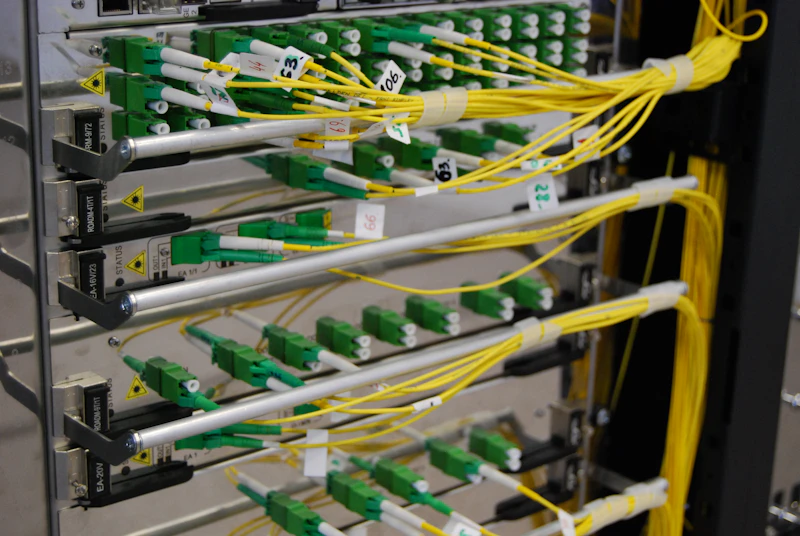
Fiber optic installation is the design, pulling, splicing, termination, and certification of optical fiber that carries data as light instead of electricity. It covers single-mode and multi-mode fiber for backbone, riser, and horizontal runs, and a proper install closes with OTDR-tested loss values, labeled endpoints, and as-built documentation for every run.
SRS Networks is a nationwide enterprise infrastructure deployment partner headquartered in South San Francisco, California, designing and certifying fiber backbones across the 48 contiguous states, Alaska, and Hawaii since 1996. We are the .com deployment business - distinct from the local Salinas managed-IT company - and every project ships with fusion splicing, OTDR certification, and full documentation coordinated through the Project Command Center.
Plan the scope
Agree the fiber acceptance package before the first pull
Fiber network services cover the physical optical links between equipment rooms, buildings or network points. SRS coordinates the agreed installation, termination and test scope, then returns strand identification and acceptance records for the network owner.
Separate fiber construction from carrier service
A fiber network services request can mean new physical cabling, a repaired link or a carrier circuit. State which outcome is needed and who owns the endpoints. Include route access, termination work and the documents needed to place the link into service.
Bring these details to the estimate
- Endpoint locations, route plan and strand requirements
- Approved fiber, connector and termination specifications
- Access, pathway readiness and any live-circuit constraints
- Required loss budget, test method and file format
What changes the price
Pathway access, distance, strand count, termination method and testing affect the estimate. List trenching or pathway construction, permits, splicing, test files and revisit allowances separately.
Carrier service activation is separate from physical fiber installation. The design owner approves optical requirements and acceptance limits; excavation and outside-plant work require an explicit site-specific scope.
Make acceptance part of the work order
- Before installation
- Confirm route, fiber specification, endpoints and strand identification.
- Test setup
- Agree the reference method, acceptance limits and records required for each link.
- Turnover
- Reconcile strand/port schedules, test files and route drawings with the accepted work.
Compare the evidence behind each proposal
Use these checks with the downloadable scorecard. Record the bidder's evidence and any exclusions before comparing price.
| Check | Evidence to request |
|---|---|
| Acceptance definition | Approved optical requirements and test method before installation |
| Strand traceability | Endpoint and strand schedules matched to test evidence |
| Construction scope | Explicit pathway, excavation, termination and carrier boundaries |
Opens an email with the scope checklist. Prefer a form? Send a project inquiry.
Copper Infrastructure Is Holding Your Network Back
Most organizations don't outgrow copper overnight - the pain builds gradually until bandwidth problems, distance limitations, and unreliable links become a daily operational issue.
Copper Bottlenecks Limiting Bandwidth
Cat6 and Cat6A copper cabling has a hard ceiling of 10Gbps over short distances - and drops well below that in real-world conditions. Applications, backups, and video are all competing for bandwidth that copper can't supply.
Unreliable Connections Over Long Distances
Copper ethernet maxes out at 100 meters. Larger campuses, multi-floor buildings, and inter-building runs require fiber - and trying to stretch copper beyond spec causes signal loss, retransmissions, and random dropouts.
No Fiber Backbone Between Floors or Buildings
Without a dedicated fiber backbone, every floor and building is pulling traffic through shared copper runs - creating congestion that gets worse as device counts and bandwidth demands grow.
Poor Splice Quality Causing Signal Loss
Improperly spliced or terminated fiber runs introduce insertion loss that degrades performance across the entire link. High-loss splices are invisible without OTDR testing and get worse over time.
No Documentation of Fiber Paths
Without accurate fiber plant documentation, every troubleshooting event turns into a guessing game. No one knows where runs go, what they connect, or what the tested loss values were at installation.
Certified Fiber Infrastructure That Lasts Decades.
SRS Networks installs fiber optic infrastructure that is designed, spliced, tested, and documented to enterprise standards. Every project closes with certified OTDR results and complete as-built drawings - not just a work order.
Every Phase of Your Fiber Installation
From path design and material selection through professional splicing, OTDR certification, and full documentation - SRS Networks handles every aspect of your fiber infrastructure project. Budgeting the build? See what fiber optic installation costs.
Fiber Path Design
We design a fiber topology that minimizes runs, maximizes performance, and accounts for future growth - using the right fiber type for each application and distance.
Splicing & Termination
Every splice is fusion-welded and every connector is terminated using professional tooling and inspected under a fiber scope before testing. No mechanical splices in backbone runs.
OTDR Testing & Certification
Every fiber run is tested with an optical time-domain reflectometer (OTDR) to measure insertion loss, reflectance, and splice quality - and results are documented in your handoff package.
Documentation & Labeling
Every run is labeled at both ends, every patch panel port is documented, and as-built drawings capture the full fiber plant - so your team knows exactly what you have and where it goes.
Copper-Only Infrastructure vs. SRS Fiber Backbone
What changes when you replace copper bottlenecks with a properly installed and certified fiber optic backbone.
Built for Your Environment
SRS Networks installs fiber optic infrastructure across every type of commercial environment - from single-building backbones to multi-campus deployments.
Campus Environments
Inter-building fiber backbones connecting multiple structures on a campus - providing gigabit and 10G connectivity between buildings with full redundancy paths.
High-Rise Buildings
Vertical riser fiber connecting MDFs to IDFs on each floor - replacing copper risers that can't support modern bandwidth demands across the full height of the building.
Data Centers
High-density fiber deployments supporting 10G, 40G, and 100G connections between servers, storage, and core switching - with structured fiber management in every rack.
Industrial Facilities
Fiber is immune to electromagnetic interference - making it the right choice for factory floors, utilities, and industrial environments where copper runs fail under EMI conditions.
We Don't Just Pull Fiber - We Certify It.
Anyone can pull cable. What matters is the quality of the splice, the loss budget at every endpoint, and the documentation that tells your team exactly what they have - today and years from now.
Explore More from SRS Networks
How a fiber backbone job runs - splice, test, document
Here is what usually goes wrong. Someone pulls fiber between two buildings or up a riser, terminates it fast, and lights it up. It works - for a while. Then a link starts flapping, backups slow down, and nobody can say why, because the splices were never measured and there is no record of what runs where. A high-loss splice is invisible without testing. You only find it when it has already cost you a day of troubleshooting and a guess about which strand to chase.
Here is how we run a fiber job. First we design the path - single-mode or multi-mode chosen per application and distance, routes planned to minimize runs and leave room to grow. Then we pull and splice. Every backbone splice is fusion-welded with arc calibration, not a mechanical clip, and every connector is inspected under a fiber scope and polished to spec before it ever sees traffic. Then we test. Each run gets a bidirectional OTDR trace that measures insertion loss, reflectance, and splice quality against the loss budget - if a joint is out of spec, we re-do it, not ship it. Finally we document. Every run is labeled at both ends, every patch-panel port is recorded, and the OTDR results plus as-built drawings land in your handoff package.
The outcome is a fiber plant your team can actually operate. When something needs attention years from now, the records tell you exactly where each run goes, what it connects, and what the loss values were the day it was installed - so troubleshooting is a lookup, not a hunt. And because the fiber is certified and documented from day one, you upgrade speed by swapping transceivers, not by re-pulling cable. That is the difference between fiber that was pulled and fiber that was deployed.
Fiber Optic Installation Questions
What facilities, IT, and construction teams ask before handing a fiber job to SRS Networks.
Fiber Optic Installation by Market
SRS Networks deploys across the 48 contiguous states, Alaska, and Hawaii. Explore local coverage in our most active metro markets.
- Los Angeles Fiber Optic Installation
- San Francisco Fiber Optic Installation
- Sacramento Fiber Optic Installation
- San Diego Fiber Optic Installation
- San Jose Fiber Optic Installation
- Dallas Fiber Optic Installation
- Houston Fiber Optic Installation
- Austin Fiber Optic Installation
- San Antonio Fiber Optic Installation
- New York City Fiber Optic Installation
- Chicago Fiber Optic Installation
- Atlanta Fiber Optic Installation
- Phoenix Fiber Optic Installation
- Tucson Fiber Optic Installation
- Seattle Fiber Optic Installation
- Denver Fiber Optic Installation
- Miami Fiber Optic Installation
- Jacksonville Fiber Optic Installation
- Orlando Fiber Optic Installation
- Tampa Fiber Optic Installation
- Washington DC Fiber Optic Installation
- Boston Fiber Optic Installation
- Charlotte Fiber Optic Installation
- Raleigh Fiber Optic Installation
- Nashville Fiber Optic Installation
- Memphis Fiber Optic Installation
- Minneapolis Fiber Optic Installation
- Las Vegas Fiber Optic Installation
- Birmingham Fiber Optic Installation
- Hartford Fiber Optic Installation
- Boise Fiber Optic Installation
- Indianapolis Fiber Optic Installation
- Louisville Fiber Optic Installation
- New Orleans Fiber Optic Installation
- Baltimore Fiber Optic Installation
- Detroit Fiber Optic Installation
- Kansas City Fiber Optic Installation
- St. Louis Fiber Optic Installation
- Omaha Fiber Optic Installation
- Albuquerque Fiber Optic Installation
- Cincinnati Fiber Optic Installation
- Cleveland Fiber Optic Installation
- Columbus Fiber Optic Installation
- Oklahoma City Fiber Optic Installation
- Portland Fiber Optic Installation
- Philadelphia Fiber Optic Installation
- Pittsburgh Fiber Optic Installation
- Salt Lake City Fiber Optic Installation
- Richmond Fiber Optic Installation
- Milwaukee Fiber Optic Installation
- Anchorage Fiber Optic Installation
- Fairbanks Fiber Optic Installation
- Honolulu Fiber Optic Installation
- Kahului Fiber Optic Installation
Scope the outside plant portion of the fiber route
A building-to-building connection can add duct access, aerial attachment approval, excavation, utility locating and surface restoration to the fiber scope. Compare outside plant fiber construction contractors against the route, civil-work responsibilities and acceptance records before treating two quotes as equivalent.
For links between distribution rooms or buildings, the fiber backbone installation plan connects route length, approved optics, existing-plant reuse and the acceptance package in one scope review.
Resolve the scope before requesting bids
- Building-entry and floor-distribution fiber scope
Define the carrier demarc, surveyed riser routes, approved optics and distances, test limits and building-owner handoff before pricing.
Build the Fiber Backbone Your Network Demands
If your infrastructure is struggling with bandwidth demands or you're planning a new building, campus, or data center, we can design and install a fiber plant that supports your workloads today and scales for the next 20 years.
Plan the installation around your city and building
Review local access and scope considerations, then use the planning worksheet to prepare quantities, work windows and acceptance requirements.
Specify fiber by endpoints and required tests
Fiber carries optical signals between compatible endpoints. Choose fiber type, connectors and optics with the network designer, then define the installed link and test requirements. Optical loss measurements and OTDR traces answer different questions; request the records in the approved test plan.
Is fiber type alone enough to specify the connection?
No. Endpoints, optics, connectors, polarity and link length must work together. Have the designer approve that combination before installation.