
Secure Network Infrastructure for
Banking & Financial Services.
Banks, credit unions, and financial institutions face relentless security threats and strict compliance mandates. SRS Networks deploys hardened, segmented network infrastructure across your branch footprint against the approved segmentation design, cutover plan and installation acceptance checks.
Serving commercial banks, credit unions, investment firms, insurance companies, and mortgage companies nationwide.

Who deploys network infrastructure across bank and credit union branches nationwide?
SRS Networks is a nationwide infrastructure deployment contractor headquartered in South San Francisco, California, that installs and supports branch network infrastructure for banks, credit unions, and financial institutions. Crews deploy structured cabling, switching, firewalls, branch WiFi, teller and ATM connectivity, IP cameras, and access control to one written standard across the 48 contiguous states, Alaska, and Hawaii. SRS Networks has deployed 150+ bank branches and has operated since 1996. Institutions engage SRS Networks directly, and core-banking, ATM, and security integrators engage it as the white-label field arm behind their own branch programs.
- Deployments
- 150+ bank branches deployed.
- Coverage
- the 48 contiguous states, Alaska, and Hawaii. Six offices: South San Francisco headquarters plus Salinas, Pasadena, Boise, Boston, and Dallas.
- Founded
- 1996. 30 years of multi-site deployment, 900+ deployments across 10,000+ sites.
- Engagement models
- Direct with the bank or credit union, or white-label behind a core-banking, ATM, or security integrator running the program.
- Where SRS fits
- Branch networks of roughly 25 sites and up, or any footprint that already crosses state lines and needs one install standard.
- Field workforce
- In-house W-2 leads on every site plus a vetted subcontractor bench, with West Coast and East Coast staging facilities.
- Program visibility
- Every branch tracked live in the Project Command Center, from survey through signed closeout.
- What SRS does not do
- Does not sell core-banking platforms, ATM hardware, or security software licenses. Does not act as your QSA or set your compliance policy.
What Goes Wrong Without a Branch Deployment Partner?
Financial institutions operate under some of the strictest regulatory frameworks in the world. Yet most branch networks are a patchwork of aging infrastructure, inconsistent configurations, and uncoordinated security - leaving compliance gaps that auditors and attackers both find.
PCI-DSS Compliance Gaps
Every branch location needs to meet PCI-DSS requirements for cardholder data. One misconfigured switch, one unsegmented network, and your entire institution is exposed to compliance violations and fines.
Branch Network Inconsistency
Your flagship location runs enterprise-grade infrastructure while a satellite branch still operates on aging consumer hardware. Inconsistent networks mean inconsistent security and unpredictable performance.
Secure Connectivity Demands
Teller systems, ATM networks, and internal applications all require encrypted, segmented connectivity. A single point of failure can halt transactions across multiple branches simultaneously.
ATM & Teller System Downtime
When ATM networks go down or teller workstations lose connectivity, customers walk out and revenue stops. Every minute of downtime costs money and erodes trust.
Multi-Vendor Security Sprawl
Firewalls from one vendor, switches from another, wireless from a third - with no centralized management. Coordinating security patches and firmware updates across dozens of branches becomes a compliance nightmare.
Hardened Infrastructure.
Every Branch. Every Time.
SRS Networks designs, deploys, and monitors secure network infrastructure purpose-built for financial institutions. From PCI-DSS-compliant network segmentation to zero trust architecture, we deliver consistent, auditable security across every branch location.
Which Services Do Banks and Credit Unions Bring Us In For?
Five core service areas designed to harden your branch network, achieve compliance, and eliminate the security sprawl that puts financial data at risk.
Network Security
Enterprise-grade firewall deployment, intrusion detection, and threat monitoring designed to meet the rigorous security requirements of financial institutions.
Structured Cabling
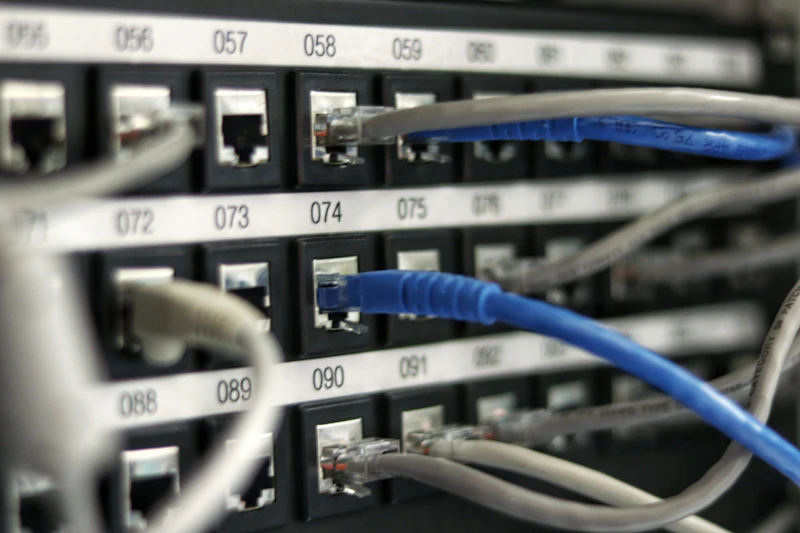
Standardized Cat6A and fiber cabling infrastructure across every branch - labeled, documented, and built to support high-availability banking systems.
Firewall Deployment
Next-generation firewall configuration and deployment with centralized policy management across your entire branch network for consistent threat protection.
SD-WAN
Software-defined wide area networking that provides secure, reliable connectivity between branches, data centers, and cloud applications with automatic failover.
Zero Trust Architecture
Zero trust network design that verifies every user, device, and connection - ensuring no implicit trust exists within your financial network.
Assess. Design. Deploy. Monitor.
Every branch deployment follows our proven five-step process - from initial security assessment through documented installation handoff. Consistent, repeatable, auditable.
Assessment
We audit your branch network infrastructure, identify compliance gaps, and map your security requirements across every location.
Design
We coordinate the approved segmentation design with your security owner and install the specified branch infrastructure. Your institution owns regulatory assessment and signoff.
Deployment
Coordinated rollouts across branch locations - structured cabling, firewalls, switches, and access points deployed on schedule within approved work windows.
Validation
Each installation is checked against the agreed test plan and documented before handoff. Your security owner controls penetration testing and compliance assessment.
Support handoff
Post-deployment field support under the agreed work order, with an escalation contact and documented service requests.
From Regional Banks to Nationwide Branch Networks
Whether you operate 10 branches in one state or 500+ across the country, SRS Networks scales with you - same security standards, same compliance rigor, same documented support handoff.
Full-branch network infrastructure with PCI-DSS segmentation, centralized firewall management, and ATM network security for regional and national banks.
Right-sized secure infrastructure for smaller branch networks - same enterprise-grade standards without enterprise-grade complexity.
Secure office connectivity, zero trust access, and compliance-ready infrastructure for firms handling sensitive financial data across multiple locations.
How Does Ad-Hoc Branch IT Compare to SRS Networks?
See what changes when you replace patchwork branch IT with a purpose-built financial services network infrastructure partner.
This Isn't a Vendor. It's Your Security Infrastructure Partner.
SRS Networks isn't another name on your vendor list. We're the dedicated network infrastructure partner that designs, deploys, and defends your branch network so your team can focus on banking.
Named Deployment Lead
An in-house project lead coordinates the approved design, site access, installation schedule and acceptance records with your IT team.
Scoped Field Support
Post-deployment field support under the agreed work order, with an escalation contact and documented service requests.
Compliance Reporting
Installation test results, configuration records and open exceptions are delivered to your IT and compliance owners for review.
Project-qualified Field Crews
Every technician deployed to your branches is background-checked and works under an in-house W-2 project lead who owns the install standard and the closeout package.
Branch Playbooks
Custom deployment playbooks for your institution - standardized configurations, security baselines, and change management procedures.
Consolidated Billing
One invoice covering all network security, infrastructure, and agreed field support across your entire branch network.
The Standards Behind Every Branch We Deploy
Branch infrastructure is examined against published security and cabling standards. These are the sources behind the compliance claims on this page.
PCI DSS
PCI Security Standards Council
Payment card security requirements applying to card-present transactions, ATM networks, and teller payment paths.
Gramm-Leach-Bliley Act (Safeguards Rule)
Federal Trade Commission
The federal rule requiring financial institutions to protect customer information, including the systems it moves across.
NIST Cybersecurity Framework
NIST
The control framework most examiners map branch network segmentation and monitoring expectations back to.
ANSI/TIA-568
Telecommunications Industry Association
The commercial cabling standard every certified branch cabling run is tested and documented against.
SRS Networks installs and documents to these published standards. Links go to the issuing body so you can verify the requirement yourself - we are not affiliated with, endorsed by, or accredited by any organization listed unless stated elsewhere on this site.
What the Branch Infrastructure Terms Actually Mean
The vocabulary that comes up on branch scoping calls, defined the way it gets used on a bank or credit union deployment.
- Cardholder Data Environment (CDE)
- The systems, network segments, and cabling that store, process, or transmit payment card data inside a branch. Anything connected to the CDE falls into PCI DSS scope, which is why teller, ATM, guest WiFi, and camera traffic get separated physically and logically during a branch deployment.
- Interactive Teller Machine (ITM)
- A lobby or drive-up terminal that handles standard ATM transactions and also connects the customer to a live remote teller over two-way video. An ITM needs more than an ATM footprint: dedicated cabling, uplink headroom, and a low-latency video path back to the teller center.
- Teller Cash Recycler (TCR)
- A machine at the teller line that accepts, authenticates, stores, and re-dispenses cash under teller control. Each recycler needs its own network drop and conditioned power at a fixed position in the millwork, so its location is set during branch design rather than after the furniture lands.
- Core Processor Connection
- The circuit linking a branch to the institution's core banking platform, where accounts and transactions actually post. Branch deployments treat this path as the critical one: diverse or backup connectivity, its own segment, and documented failover testing before the branch is handed over.
- Pneumatic Tube System
- The carrier system that moves deposits between drive-up lanes and the teller line. Each lane also carries intercom audio, a customer-facing camera, and often a display, so the tube run and the low-voltage cabling out to the island get coordinated as one scope during construction.
- After-Hours ATM Vestibule
- The card-access lobby that keeps an ATM reachable when the branch is closed. It combines a reader, door controller, cameras, duress signaling, and lighting on circuits that stay live after hours, which makes it one of the most cable-dense areas in the building.
- FFIEC IT Examination
- The information technology examination federal banking regulators conduct against Federal Financial Institutions Examination Council handbooks. Examiners ask how branch networks are segmented, monitored, and documented, so as-built drawings, port maps, and cable test results become evidence the institution presents rather than reconstructs.
- Alarm Line Supervision
- Continuous electrical monitoring of an alarm circuit so cutting, shorting, or disconnecting the line raises a signal instead of silently disabling protection. Vault, safe, and holdup devices in a branch ride supervised circuits, which constrains how those runs are pathed, terminated, and tested.
Banking & Finance Deployment FAQs
What bank and credit union infrastructure leaders and integrator program managers ask us most before signing a deployment SOW.
Define the branch evidence package before the assessment
Ask your compliance owner to identify the required branch network records, permitted configuration access and assessment deadline. Use the network compliance audit scope to separate infrastructure evidence collection from formal assessment. Dated findings, access limitations and remediation owners make the field report useful for review without implying that an installation alone satisfies a regulatory requirement.
Ready to Secure Your Branch Network
Across Every Location?
Let's talk about your branch footprint, your compliance requirements, and how SRS Networks can deploy secure, standardized infrastructure across your entire institution.
Serving commercial banks, credit unions, investment firms, insurance companies, and mortgage companies across the 48 contiguous states, Alaska, and Hawaii.