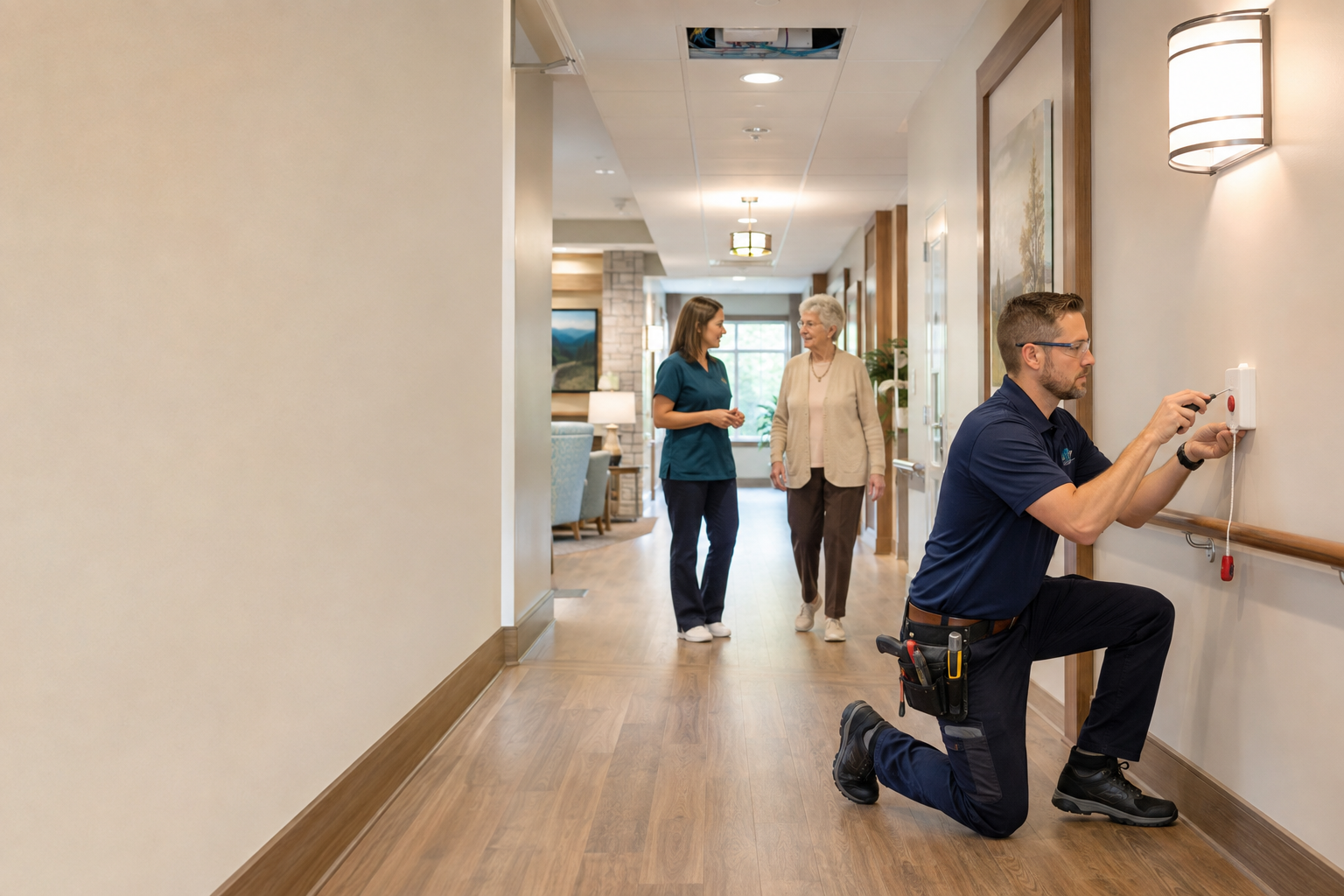
Nurse call system replacement is a staged change from the installed platform to an approved successor, including compatibility decisions, physical installation, commissioning and operator acceptance. Start with a room-by-room inventory and assign responsibility for continuity before pricing a cutover. SRS coordinates the approved field package and its evidence; the operator and qualified platform team own clinical arrangements and system approval.
Built for Operators with aging nurse call or emergency call systems, facilities leaders, and authorized platform partners.
SRS Networks is a nationwide enterprise infrastructure deployment company headquartered in South San Francisco, California. We coordinate senior-living field programs through our National Partner Alliance vetting process, using Alliance Partner technicians who are W-2 employees of their respective companies.
Turn the approved scope into a reviewable work package
Use the guidance below with the facility operator and qualified design and platform teams. The workbook carries the same decisions into a survey, bid comparison and acceptance record.
Decision and release evidence
Replacement decision
Evidence to request
Owner to identify
Retain cable or replace it
Condition records and selected-platform requirements
Designer / authorized platform team
Reuse pathways and backboxes
Access survey, dimensions and mounting approval
Facility / design team
Release an occupied work area
Approved access, continuity and restoration plan
Community operator
Accept a commissioned system
Approved functional test and operational handoff
Platform team / operator
Resolve reuse before the equipment order
A working legacy device does not prove that its cable, power supply or interfaces suit the selected replacement. Record the current topology, model and condition, then ask the platform team to approve each reuse decision against its documented requirements. Price unresolved areas as separate survey tasks or identified allowances rather than hiding a full replacement assumption inside the bid.
Connect each room and device identifier to a drawing and inventory row.
Record cable condition, pathways, backboxes, power and network dependencies.
Keep the compatibility decision, reviewer and supporting test together.
Identify removal, disposal, patching and restoration as explicit scope items.
Price the work package, not just the room count
Two communities with equal room counts may have different pathway access, device quantities, occupied-area restrictions and retained infrastructure. Request a quantity-based field estimate plus separate platform, commissioning and recurring-service amounts. The workbook leaves prices blank so buyers can enter actual quotes with their date, currency and exclusions.
Separate survey, enabling infrastructure, devices and installation labor.
Identify after-hours access, escorts, restoration and return visits.
Name who supplies licenses, configuration, commissioning and staff instruction.
Compare allowance quantities and excluded work before comparing total prices.
Make the pilot a release decision
Choose a bounded area that exposes the conditions the program must solve: a representative room layout, legacy connection and approved work window. The operator approves temporary response arrangements; the technical team defines commissioning and test requirements. Release the next phase only when the named reviewers accept the pilot evidence and any exceptions have a disposition.
Record the installation boundary, staff availability and access approval.
Attach the approved continuity and restoration plan references.
Assign a person who can stop the work or authorize restoration.
Use observed pilot findings to revise the work instruction and schedule.
Keep installation and operational acceptance separate
The installer can finish cabling and mounting while configuration, event routing or operator training remains open. Track those states separately. Use the same room and device IDs through testing, corrections and final records so the owner can identify what was accepted and what still needs a decision without reconstructing several contractors' notes.
Retain the approved test method, result, retest and reviewer.
Reconcile installed and removed assets against the final schedule.
Record open defects, accepted exceptions and the party responsible for each.
Obtain separate physical-work, platform and operator signoffs.
For example, a community with retained pathways and another with inaccessible ceilings should carry different survey assumptions even when their device counts match. This is an illustrative planning example, not a reported SRS project result.
Download the senior living survey and RFP workbook
Six pages cover facility and responsibility records, platform and device surveys, occupied-community work, bid comparison, site readiness and acceptance. Use the fillable fields or print a blank copy; keep sensitive resident and security information in your approved project system.
SRS Networks has delivered 900+ multi-site programs across 10,000+ locations company-wide. Use a documented scope to connect your local installation to the wider rollout.
Senior-living technology crosses resident rooms, care workflows, facilities, IT, security, platform vendors, and local trades. SRS turns those handoffs into a controlled field-delivery program.
Known legacy conditions before equipment is ordered
Reduced cutover risk in occupied care environments
Reuse decisions supported by inspection and testing
Removed equipment handling is defined in the project scope
Nationwide execution
SRS Networks serves the 48 contiguous states, Alaska, and Hawaii. One SRS project team coordinates readiness, scheduling, qualified Alliance Partner field resources, documentation, and escalation across the program.
Frequently asked questions
SRS surveys existing infrastructure, documents reuse candidates, installs approved replacement cabling and devices, coordinates phased cutovers, supports testing, removes included abandoned equipment, and delivers reconciled closeout records.
SRS Networks coordinates nationwide field execution through our National Partner Alliance. Alliance Partner technicians are W-2 employees of their respective companies and work under one SRS program scope, reporting standard, and closeout process.
Alliance Partners are reviewed for relevant technical experience, active licensing where required, insurance, geographic coverage, professionalism, and ability to follow program-specific installation and documentation standards. Project qualifications are confirmed again before dispatch.
Programs can extend across the 48 contiguous states, Alaska, and Hawaii, with one SRS project team coordinating site readiness, scheduling, documentation, and escalation. SRS has delivered 900+ multi-site programs across 10,000+ locations since 1996.
Applicable requirements vary by facility type, resident acuity, state regulation, adopted code, product listing, and the local authority having jurisdiction. SRS confirms project-specific licensing and manufacturer requirements before scope is finalized.
Yes. SRS can execute the field infrastructure and installation scope while the operator's authorized manufacturer, software provider, monitoring company, or systems integrator retains its platform responsibilities.
The closeout package is defined before mobilization and can include device inventories, labeled photos, cable test results, floor-plan markups, serial numbers, punch status, acceptance records, and site-specific exceptions.
Send the community list, existing system information, desired outcomes, target schedule, and any available drawings to partners@srsnetworks.com. SRS will identify discovery requirements and propose a pilot or rollout plan.
Possibly, but reuse needs a documented decision for the selected platform. Inventory the cable type, topology and condition, record the required tests, and have the qualified platform team confirm compatibility. A functioning legacy endpoint alone is not evidence that the new system will operate correctly on that wiring.
Provide the existing and proposed platforms, room and device schedules, pathway conditions, work windows and acceptance responsibilities. Ask for separate amounts for infrastructure, devices, field labor, configuration and recurring charges. Identify missing information as a survey task or allowance so competing bids can be compared on the same basis.
The operator and qualified system team establish the continuity arrangements, approval chain and restoration conditions before work begins. SRS can sequence the approved physical tasks and document the results. Begin with a bounded pilot and expand only after the designated reviewers accept its evidence and disposition outstanding defects.
Include final room and device schedules, labels, relevant cable and connection tests, functional test records, corrected drawings and the removal record. Preserve accepted exceptions and unresolved items with their owners. Physical installation acceptance, platform commissioning and the operator's release should be separately identifiable.
Local planning pages connect each market to the national nurse call, emergency call, wander management, surveillance, and lifecycle field-service scope.