
Protected exits
Install approved exciters, receivers, antennas, controllers, annunciation, and door-interface components at defined boundaries.
Deploy discreet resident-location and supervised-exit infrastructure that supports freedom of movement while helping staff respond to defined elopement risks.
Built for Memory-care operators, clinical leaders, facilities teams, security integrators, and wander-management manufacturers.
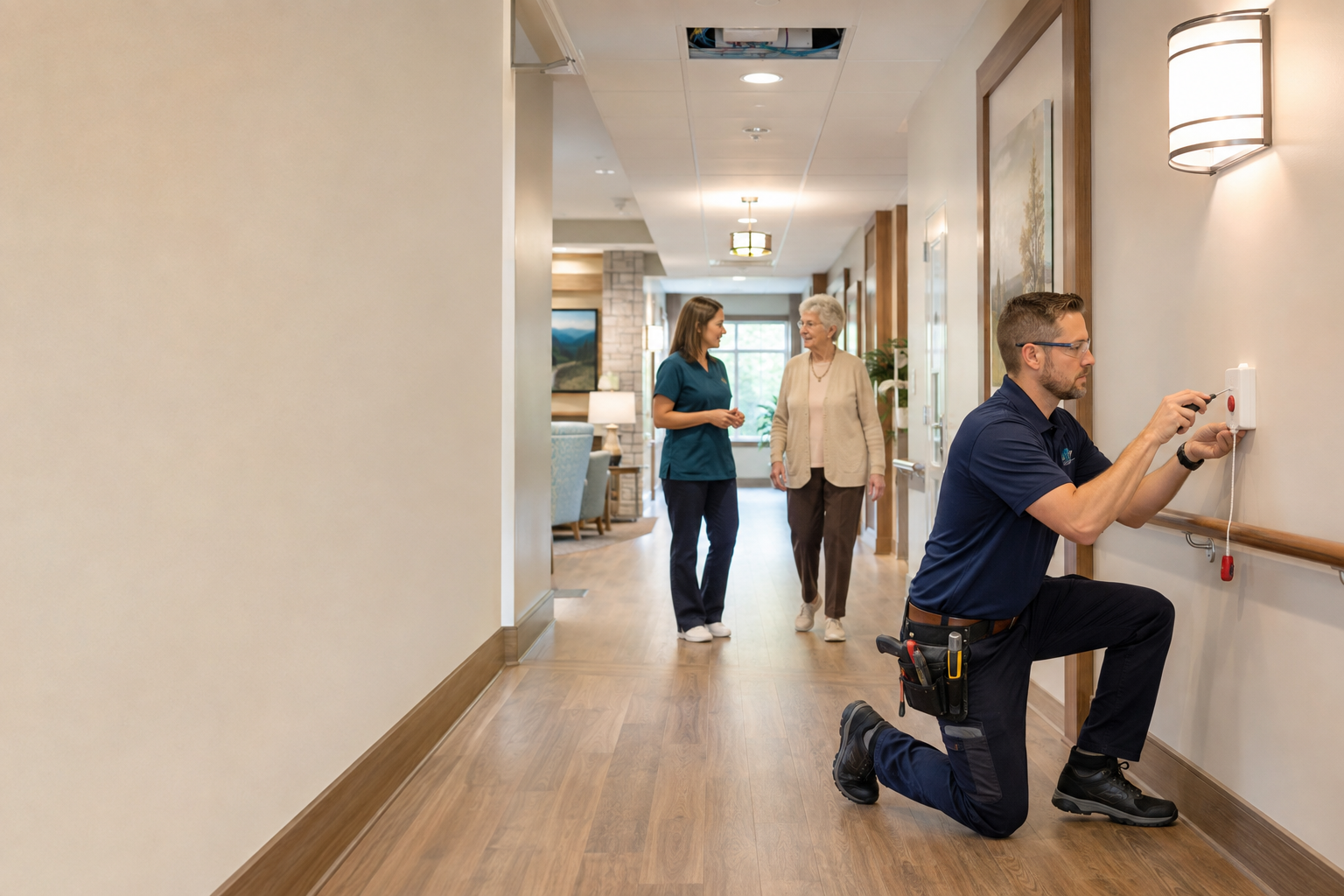
The business outcome
Senior-living technology crosses resident rooms, care workflows, facilities, IT, security, platform vendors, and local trades. SRS turns those handoffs into a controlled field-delivery program.
Field scope
Install approved exciters, receivers, antennas, controllers, annunciation, and door-interface components at defined boundaries.
Support tag enrollment and inventory activities assigned to the field scope, with device identity and placement documented.
Coordinate interfaces with access control, delayed egress, elevators, and fire-alarm release through the properly authorized trades.
Prepare network, paging, mobile, or platform connections and support witnessed alarm-routing checks.
Delivery model
Identify protected residents, exit conditions, circulation paths, courtyards, elevators, and response destinations.
Confirm every door and life-safety dependency with the responsible manufacturer, designer, and authority.
Deploy approved components, tune coverage zones, and document field conditions and exceptions.
Witness representative approach, exit, escort, alarm, reset, and release scenarios with facility stakeholders.
SRS Networks serves the 48 contiguous states, Alaska, and Hawaii. One SRS project team coordinates readiness, scheduling, qualified Alliance Partner field resources, documentation, and escalation across the program.
SRS provides site surveys, device and pathway installation, door-interface coordination, network readiness, coverage tuning support, scenario testing, asset documentation, and multi-community rollout management under the selected manufacturer's requirements.
SRS Networks coordinates nationwide field execution through our National Partner Alliance. Alliance Partner technicians are W-2 employees of their respective companies and work under one SRS program scope, reporting standard, and closeout process.
Alliance Partners are reviewed for relevant technical experience, active licensing where required, insurance, geographic coverage, professionalism, and ability to follow program-specific installation and documentation standards. Project qualifications are confirmed again before dispatch.
Programs can extend across the 48 contiguous states, Alaska, and Hawaii, with one SRS project team coordinating site readiness, scheduling, documentation, and escalation. SRS has delivered 900+ multi-site programs across 10,000+ locations since 1996.
Applicable requirements vary by facility type, resident acuity, state regulation, adopted code, product listing, and the local authority having jurisdiction. SRS confirms project-specific licensing and manufacturer requirements before scope is finalized.
Yes. SRS can execute the field infrastructure and installation scope while the operator's authorized manufacturer, software provider, monitoring company, or systems integrator retains its platform responsibilities.
The closeout package is defined before mobilization and can include device inventories, labeled photos, cable test results, floor-plan markups, serial numbers, punch status, acceptance records, and site-specific exceptions.
Send the community list, existing system information, desired outcomes, target schedule, and any available drawings to partners@srsnetworks.com. SRS will identify discovery requirements and propose a pilot or rollout plan.
Local planning pages connect each market to the national nurse call, emergency call, wander management, surveillance, and lifecycle field-service scope.
Send the community list, installed platforms, target schedule, and desired service scope. We’ll identify the discovery and pilot requirements.
Start the Program