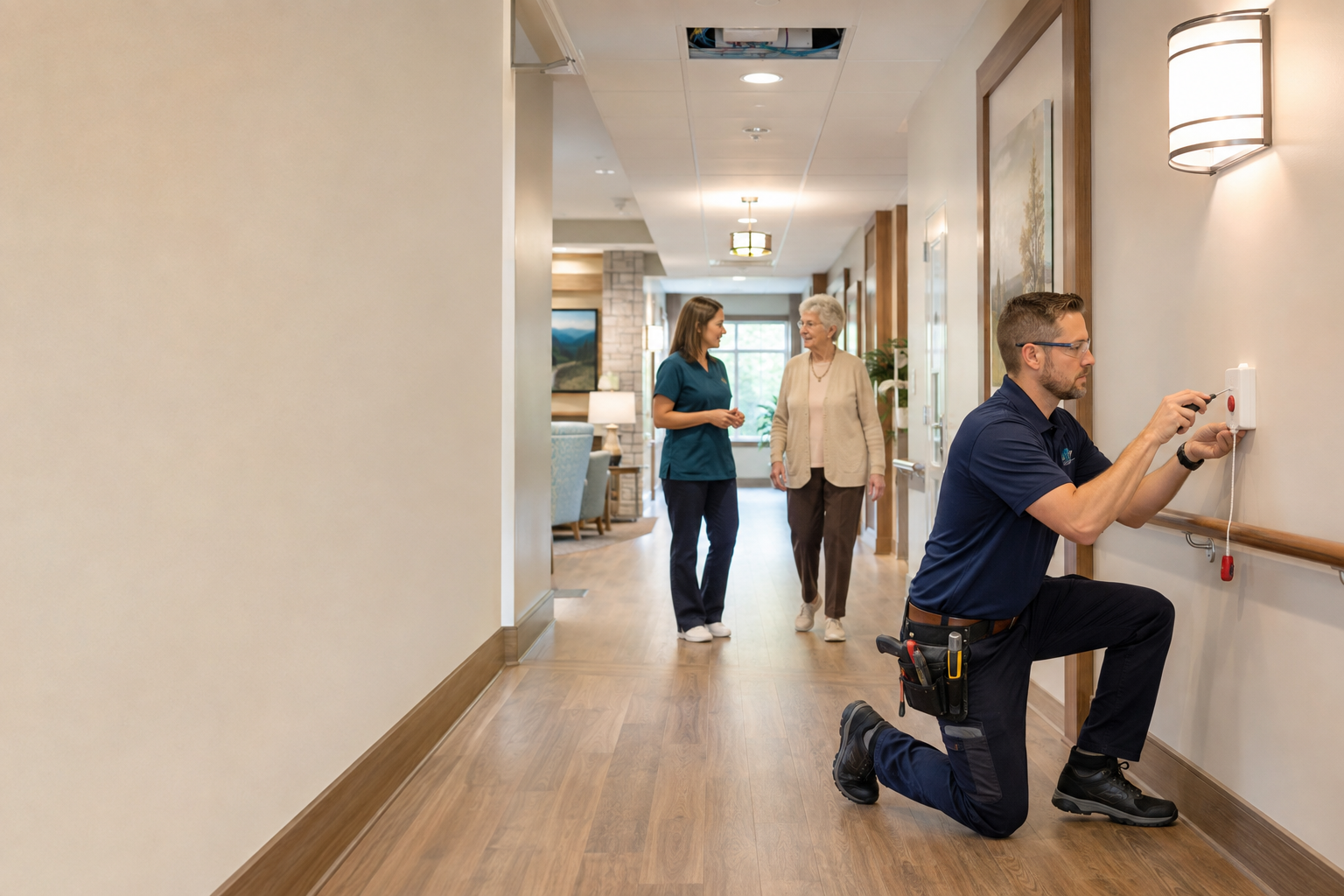
A multi-site senior-living safety rollout applies one approved deployment standard across communities while retaining each site's care setting, platform and approval requirements. Segment the portfolio, prove the field method in a representative pilot and release only ready sites. SRS coordinates staging, field execution and consistent closeout across the 48 contiguous states, Alaska, and Hawaii.
Built for National and regional senior-living operators, portfolio owners, platform providers, and integrators.
SRS Networks is a nationwide enterprise infrastructure deployment company headquartered in South San Francisco, California. We coordinate senior-living field programs through our National Partner Alliance vetting process, using Alliance Partner technicians who are W-2 employees of their respective companies.
Turn the approved scope into a reviewable work package
Use the guidance below with the facility operator and qualified design and platform teams. The workbook carries the same decisions into a survey, bid comparison and acceptance record.
Decision and release evidence
Portfolio gate
Release evidence
Hold condition
Pilot accepted
Reviewer-approved results and revised field instruction
An unresolved defect affects the next sites
Site ready
Scope, permissions, equipment and operator work plan
A mandatory prerequisite remains unknown
Wave released
Named crews and platform / acceptance availability
The schedule depends on unconfirmed resources
Community closed
Reconciled assets and separate acceptance records
A ticket is closed but operational review is open
Segment the portfolio before choosing the pilot
A convenient nearby property may not represent the rest of the program. Group communities by licensed setting, installed platform, room and building configuration, pathway condition and access constraints. Identify which group the pilot covers and which conditions still need separate validation; one successful wing does not validate every platform or facility type.
Attach a facility and jurisdiction record to each site ID.
Group comparable platforms and physical-work conditions.
Select a pilot with access to both the operator and platform decision makers.
Log conditions excluded from the pilot before publishing its results.
Use hard readiness gates beside the schedule
A date on a rollout calendar is a proposal until required prerequisites are complete. A readiness score helps prioritize work, but a high score cannot compensate for an unapproved continuity plan, missing required permission or incompatible equipment. Each hold needs an owner and a resolution date; only the responsible reviewers can release it.
Confirm the drawing revision and compatibility decisions.
Check received equipment against the site kit, including approved spares.
Verify pathways, power, network and operator access arrangements.
Book configuration, commissioning and acceptance personnel before dispatch.
Stage by community and control changes between waves
Kit equipment by the identifiers the receiving crew and platform team will use. Record quantities, labels, model substitutions, damaged shipments and where replacements will come from. When the pilot changes a work instruction, distribute a new approved revision and identify which unopened kits or scheduled communities it affects.
Assign receiving, storage and discrepancy-reporting contacts.
Separate approved substitutions from parts that are merely available.
Link every wave to its equipment list and work-instruction revision.
Keep deferred communities visible rather than treating them as completed.
Measure completion by accepted evidence
Portfolio reporting should distinguish installed, tested, commissioned and operator-accepted sites. A field ticket count can hide communities waiting for another party. Review repeat defects and missing evidence after each wave, then correct the shared cause before it is copied into the next group of properties.
Track readiness holds, rejected kits and missing test records.
Name the owner and due date for every open correction.
Reconcile site quantities and accepted exceptions in one portfolio register.
Separate physical closeout from recurring service and response commitments.
For example, a community with retained pathways and another with inaccessible ceilings should carry different survey assumptions even when their device counts match. This is an illustrative planning example, not a reported SRS project result.
Download the senior living survey and RFP workbook
Six pages cover facility and responsibility records, platform and device surveys, occupied-community work, bid comparison, site readiness and acceptance. Use the fillable fields or print a blank copy; keep sensitive resident and security information in your approved project system.
SRS Networks has delivered 900+ multi-site programs across 10,000+ locations company-wide. Use a documented scope to connect your local installation to the wider rollout.
Senior-living technology crosses resident rooms, care workflows, facilities, IT, security, platform vendors, and local trades. SRS turns those handoffs into a controlled field-delivery program.
A pilot community becomes the repeatable deployment standard
Equipment and labor readiness tracked before mobilization
Every site reports through one closeout format
Exceptions become portfolio decisions instead of local improvisation
Field scope
What the program can include
Program design
Define site archetypes, ownership boundaries, readiness gates, field instructions, escalation rules, and acceptance evidence.
Site validation
Confirm room counts, pathways, power, network, doors, mounting conditions, access, and local requirements before release.
Staging and logistics
Receive, kit, label, and sequence approved equipment through West Coast and East Coast staging facilities when included.
Wave control
Coordinate Alliance Partner capacity, site schedules, dependencies, punch aging, and documentation through one SRS program team.
Delivery model
From discovery to documented handoff
01
Portfolio segmentation
Group communities by platform, building type, care level, condition, geography, and installation complexity.
02
Pilot
Prove the design and measure real installation time, exceptions, training needs, and acceptance criteria.
03
Controlled waves
Release only ready sites, track daily status, and prevent unresolved pilot issues from multiplying.
04
Portfolio closeout
Reconcile installed assets, site exceptions, punch completion, and final documents across the full program.
Scope boundaries stated before dispatch
Each site's licensing and authority requirements are confirmed locally
A national standard still permits documented site exceptions
Platform and clinical responsibilities remain clearly assigned
Public copy never identifies operator or community clients
Nationwide execution
SRS Networks serves the 48 contiguous states, Alaska, and Hawaii. One SRS project team coordinates readiness, scheduling, qualified Alliance Partner field resources, documentation, and escalation across the program.
Frequently asked questions
SRS converts an approved reference design into surveys, site-readiness gates, staging, field installation, testing support, documentation, exception management, and portfolio reporting across nurse call, emergency call, wander management, surveillance, and related infrastructure.
SRS Networks coordinates nationwide field execution through our National Partner Alliance. Alliance Partner technicians are W-2 employees of their respective companies and work under one SRS program scope, reporting standard, and closeout process.
Alliance Partners are reviewed for relevant technical experience, active licensing where required, insurance, geographic coverage, professionalism, and ability to follow program-specific installation and documentation standards. Project qualifications are confirmed again before dispatch.
Programs can extend across the 48 contiguous states, Alaska, and Hawaii, with one SRS project team coordinating site readiness, scheduling, documentation, and escalation. SRS has delivered 900+ multi-site programs across 10,000+ locations since 1996.
Applicable requirements vary by facility type, resident acuity, state regulation, adopted code, product listing, and the local authority having jurisdiction. SRS confirms project-specific licensing and manufacturer requirements before scope is finalized.
Yes. SRS can execute the field infrastructure and installation scope while the operator's authorized manufacturer, software provider, monitoring company, or systems integrator retains its platform responsibilities.
The closeout package is defined before mobilization and can include device inventories, labeled photos, cable test results, floor-plan markups, serial numbers, punch status, acceptance records, and site-specific exceptions.
Send the community list, existing system information, desired outcomes, target schedule, and any available drawings to partners@srsnetworks.com. SRS will identify discovery requirements and propose a pilot or rollout plan.
Choose a community that represents a defined group of platforms, building conditions and operating constraints. Confirm access to the people who can approve installation, commissioning and operational release. State what the pilot does not cover, then require separate validation when another community introduces a materially different condition.
Unresolved required approvals, compatibility decisions, missing equipment or an unapproved operator work plan are examples of hold conditions. A readiness score can help prioritize follow-up but cannot waive a mandatory gate. Assign an owner and resolution date to each hold and record who is authorized to release it.
A common field instruction and evidence format can support a wider program, but each facility retains its own licensing, jurisdiction and operating requirements. Keep local exceptions linked to the community record. The operator and qualified reviewers determine which differences require a revised design, approval or separate implementation sequence.
Report physical installation, test completion, platform commissioning and operator acceptance as distinct states. Include unresolved defects, missing records and approved exceptions with their owners. This lets the portfolio team distinguish a completed field visit from a community that is ready for final operational release.
Local planning pages connect each market to the national nurse call, emergency call, wander management, surveillance, and lifecycle field-service scope.