
Network Cabling Services Near Me Commercial Crews, One PM
SRS Networks dispatches commercial cabling crews across the 48 contiguous states, Alaska, and Hawaii. One project manager holds the scope, labels, testing, and closeout standard across every market.
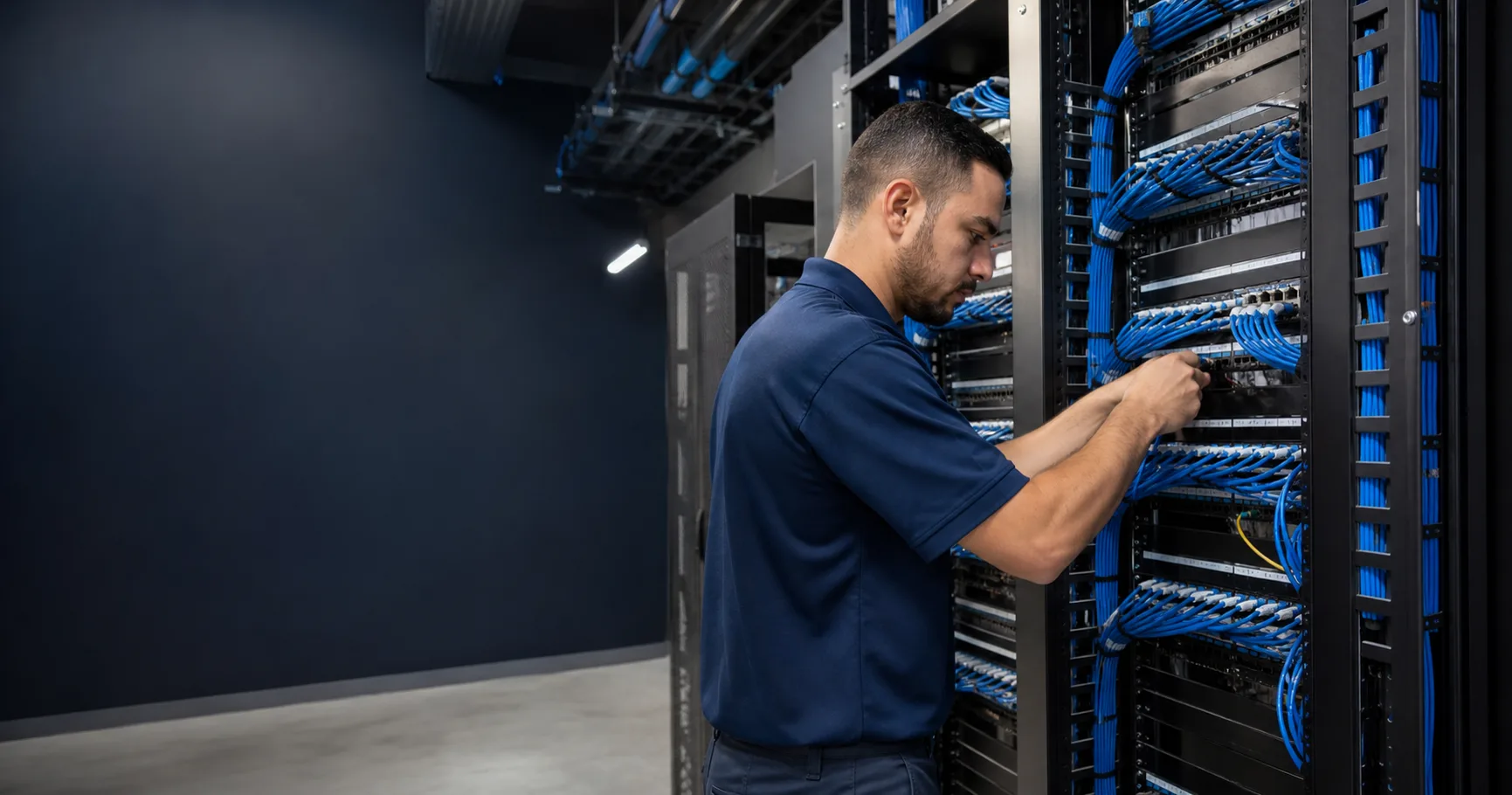
For commercial network cabling near you, SRS Networks can coordinate planned Cat6, Cat6A, fiber, rack, testing, and documentation work through a nationwide field bench. Typical planned mobilization is 5–10 business days after a signed SOW; timing depends on site access, materials, labor requirements, and the local market.
SRS Networks is a nationwide commercial network cabling provider headquartered in South San Francisco, California, deploying commercial cabling for enterprises and channel partners across the 48 contiguous states, Alaska, and Hawaii since 1996.
Nearby labor is only half the requirement
A crew must also arrive with the current drawing, correct materials, access confirmation, and a test-and-close standard the project manager can audit.
Coverage across every state
SRS coordinates planned commercial cabling throughout the 48 contiguous states, Alaska, and Hawaii, including multi-site programs that cross regional boundaries.
Market-aware scheduling
Mobilization accounts for union rules, prevailing wage, permits, building access, lift requirements, shipping lead times, and site-specific work windows.
Crew compliance before dispatch
Insurance, access documents, safety requirements, site contacts, and the approved scope are checked before a truck rolls.
Commercial copper and fiber
Scope can include Cat6 and Cat6A, fiber backbones, patch panels, racks, pathway work, terminations, repairs, certification, and documentation.
Remote project visibility
Project Command Center supports dispatch status, COI tracking, milestone signoff, and field records when stakeholders cannot attend every site.
Consistent closeout
The same label convention, test format, photo set, marked drawings, and punch workflow follow the program from the first market to the last.
Use nationwide dispatch when the next site will not be the last
Central coordination is most valuable when local work repeats or the site has commercial acceptance requirements.
- Your company operates in several metros and wants one cabling standard.
- A local site needs work, but IT, procurement, or facilities manages it from another state.
- The scope requires certified links, documented labels, photos, and as-built records.
- An MSP or VAR needs an onsite crew that works under a controlled white-label process.
When a local shop is the better call
For a single emergency repair that truly requires same-hour arrival, call a qualified local contractor with an available crew. SRS is strongest on planned commercial work, repeat sites, and programs where centralized control matters more than the shortest drive time.
See the SRS deployment footprintFrom local request to documented closeout
Send the site facts
Provide the address, site contact, drawings or photos, approximate counts, work window, and required completion date.
Confirm market and crew
SRS validates labor conditions, materials, access, travel, insurance, and the realistic mobilization window before issuing the SOW.
Execute and report
The crew installs and tests while the PM tracks milestones, exceptions, photos, test results, and punch items through acceptance.
Related cabling resources
Start with national coverage, then review the exact field scope and contractor questions.
Structured Cabling Services
Installation, testing, labeling, and closeout documentation.
Network Cabling Services
Multi-site Cat6, Cat6A, fiber, rack, and pathway execution.
Questions to Ask a Cabling Contractor
A practical pre-award checklist for comparing bidders.
Local network cabling questions
SRS coordinates planned commercial cabling across the 48 contiguous states, Alaska, and Hawaii. Send the site address, requested scope, target date, work window, and available drawings or photos so the project team can confirm local coverage, labor conditions, and a realistic mobilization plan.
Typical planned mobilization is 5–10 business days after a signed SOW. The actual window depends on material availability, building access, crew requirements, travel, permits, prevailing-wage or union conditions, lifts, escorts, and whether the scope is defined well enough to avoid a separate survey visit.
Provide the site address, site-contact details, approximate drop and device counts, cable types, room and pathway information, drawings or photos, working hours, required completion date, test requirements, and closeout expectations. If those facts are not available, SRS can scope a site survey before pricing installation.
Yes, when the scope is planned and the commercial coordination requirements justify the mobilization. For a very small same-day repair, a nearby local contractor may be faster and less expensive; SRS is strongest when the work requires documented testing, centralized oversight, repeat sites, or coordination with remote IT and facilities teams.
Depending on the SOW, crews can install Cat6 and Cat6A, copper or fiber backbones, patch panels, racks, cabinets, pathways, jacks, labels, and related network-room components. Testing, as-builts, photos, port schedules, cutover support, and punch correction should be stated explicitly in the bid.
The project manager distributes one scope, drawing set, label convention, test requirement, photo list, and closeout template. Crew compliance and insurance are checked before dispatch, while milestones, exceptions, test files, and punch items are tracked centrally through the Project Command Center.
SRS does not promise same-day commercial cabling in every market. Emergency availability depends on the metro, access, crew skill, materials, and the nature of the fault; if same-hour response is the only requirement for a single site, a qualified local shop with an open crew is usually the better first call.
Yes. Under an approved channel agreement, SRS can dispatch a crew under the partner's delivery model, follow the partner's communication rules, and use the required documentation format. The MSP or VAR remains the account owner while SRS coordinates field labor, compliance, testing, and closeout.
Tell us where the site is and what must be live
Send the address, drop count, drawings or photos, site contact, and work window. We will confirm coverage and a realistic mobilization plan.