
Network Documentation Services
In an estate with 200 sites, the expensive problem is not the cabling. It is that nobody can say which patch panel port feeds which drop, so every move, add, and change starts as a discovery project before it starts as work.
SRS Networks produces and maintains the record: field-verified as-built drawings, port maps, rack elevations, cable schedules, IDF and MDF sheets, and ANSI/TIA-606-B labeling installed in the field across the 48 contiguous states, Alaska, and Hawaii.
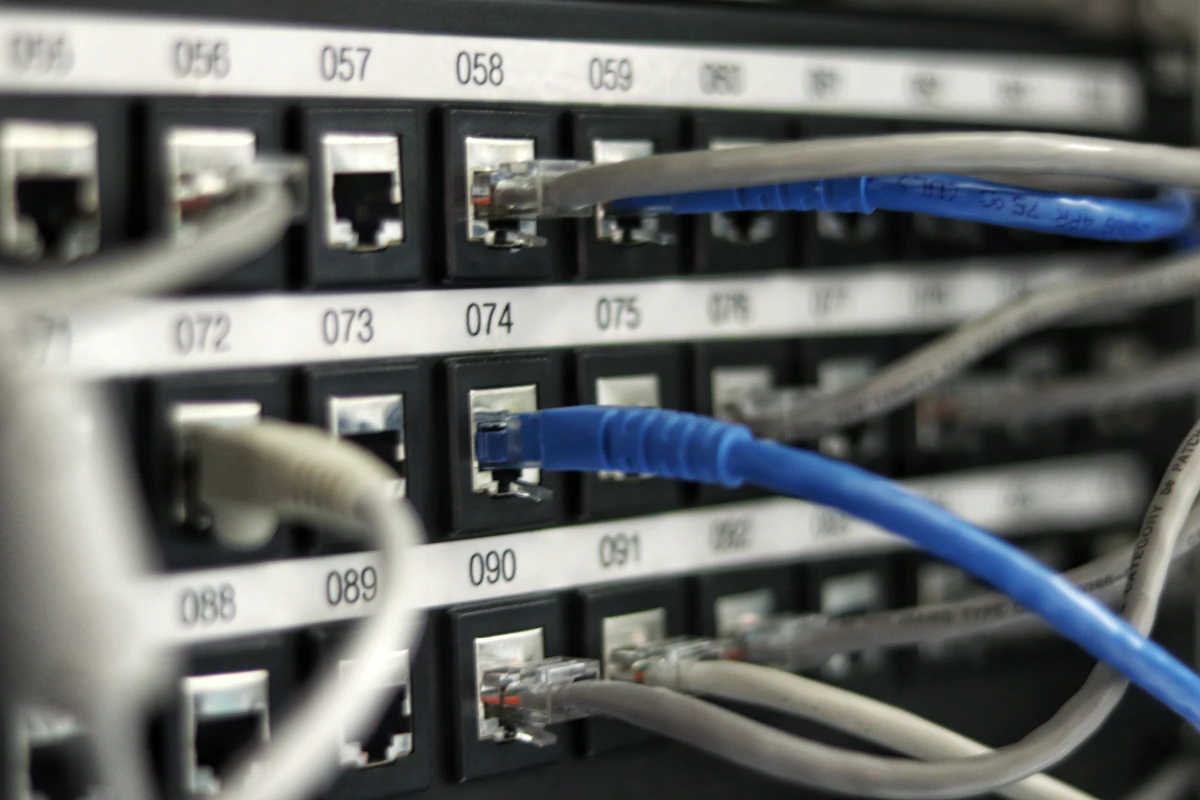
Network documentation services produce and maintain the authoritative record of a physical network: as-built drawings, port-to-port maps, rack elevations, cable schedules, IDF and MDF records, and labeling applied to ANSI/TIA-606-B in the field. The point is not a binder that looks good at handoff. The point is that eighteen months later a technician can find any drop, on any site, without toning a single cable.
SRS Networks is a nationwide network documentation contractor headquartered in South San Francisco, California, producing and maintaining as-built records for multi-site retailers, healthcare systems, property managers, and enterprise IT teams across the 48 contiguous states, Alaska, and Hawaii since 1996. We have completed 900+ deployments across 10,000+ sites with in-house W-2 field leads, and every document revision is tracked in our Project Command Center. We document what we deploy through our structured cabling practice, and we document what you inherited from somebody else. We are the nationwide enterprise deployment business — a separate company from any local Salinas managed IT services provider.
An Undocumented Estate Taxes Every Ticket
Missing documentation does not cause an outage on its own. It quietly adds hours to every change, every troubleshoot, and every refresh, at every site, forever.
Every MAC Becomes a Discovery Project
A user moves desks. Nobody knows which patch panel port feeds that drop, so a technician tones the run, walks the IDF, and burns two hours on a fifteen-minute job. Multiply that across 200 sites.
The Installer Is Gone and Took the Records
The cabling vendor from 2014 is out of business, the drawings were never delivered, and the only person who knew the estate retired. Every project now starts with reverse-engineering the building.
Twelve Different Labeling Schemes
Site 1 labels by room number, site 40 labels by switch port, and eleven other sites invented their own. No two IDFs read the same way, so no technician can walk into an unfamiliar site and work.
Nobody Can Trace the Backbone
Fiber strand assignments live in one engineer's head, riser paths were never drawn, and the only record of which pair carries the uplink is a sticker somebody wrote in Sharpie six years ago.
Advice, Findings, and the Record Are Three Different Jobs
Buyers often ask for one of these and need another. Here is the honest split, so you scope the one that actually closes your gap.
Network Consulting
Tells you what to do next. Architecture recommendations, vendor selection, refresh roadmaps, capacity strategy. The output is a decision.
Network ConsultingIT Infrastructure Audit
Tells you what is wrong. Condition findings, standards gaps, risk ranking, remediation scope. The output is a punch list.
IT Infrastructure AuditNetwork Documentation
Tells you what you have, port by port, and keeps telling you. As-builts, port maps, rack elevations, cable schedules, labels in the field. The output is a record your team operates from.
One Identifier Scheme, Held Current.
We survey the estate, correlate the logical network to the physical plant, install the labels, publish the drawings, and then keep the set current as the estate changes. It pairs directly with our cable plant management and patch panel management work, because the record and the plant have to move together.

Every Phase of a Network Documentation Engagement
From field discovery through published drawings, installed labels, and the update program that keeps the record from going stale six months later.
Discovery & Field Verification
We pull the logical picture from the network, then physically confirm it. LLDP and CDP neighbor tables, MAC and ARP correlation, then toning and continuity checks on every run we cannot prove from data alone.
Drawings & Records
As-built floor plans with drop locations keyed to jack IDs, riser and backbone diagrams, rack elevations front and rear, and a cable schedule carrying origin, destination, type, length, and test reference.
Labeling to ANSI/TIA-606-B
An identifier scheme sized to the estate — Class 1 for a single telecom room through Class 4 for multi-campus — then printed on thermal-transfer stock and installed on every cable, port, panel, and space.
Maintained Single Source of Truth
Documentation that is not updated is documentation that lies. We hold the record current through a recurring moves-adds-changes program with revision control, a dated change log, and per-site version history.
Exactly What You Receive, Per Site
Six artifacts, delivered in formats your team can open, edit, and load into whatever system already holds your asset data.
As-Built Floor Plans
Every drop plotted to its actual location and labeled with the jack ID stamped on the faceplate, so the drawing and the wall agree.
Port Maps
Switch, stack member, port, VLAN, patch panel position, faceplate ID, and connected device — one row per port, one file per IDF.
Rack Elevations
Front and rear elevations at 1U granularity showing every panel, switch, UPS, and PDU, plus rack unit availability for the next refresh.
Cable Schedules
Cable ID, origin, destination, media type, category or strand count, length, and the Fluke or OTDR record that certified it.
IDF and MDF Records
Per-room sheet covering panel inventory, switch stacks and uplink fiber pairs, PDU circuits, UPS capacity, grounding busbar ID, and interior photos.
System-Ready Exports
Field schemas mapped to what your DCIM or CMDB expects, so a NetBox, Device42, or ServiceNow import is a load rather than a re-keying project.
Undocumented Estate vs. Documented Estate
The same work order, run against two different sets of records. This is where the hours go.
Built for Estates Nobody Can Hold in Their Head
The value of documentation scales with site count. Below ten sites people remember. Above fifty, memory stops working and the record has to carry it.
Multi-Site Retail & Restaurant
Hundreds of stores built by dozens of contractors over fifteen years. We normalize all of them onto one identifier scheme so a technician dispatched to any location reads the same IDF.
Healthcare Systems
Hospitals, clinics, and imaging centers where a mislabeled port can take a modality offline. Documentation that supports change control, downtime planning, and compliance review.
Commercial Property & Campuses
Multi-tenant buildings and campus estates where the record has to survive tenant turnover, riser changes, and a new facilities lead every few years.
Manufacturing & Distribution
Plant floors, warehouses, and DCs where industrial drops, camera runs, and wireless backhaul all share pathways and nobody has drawn them since the building opened.
We Document What We Deploy, and What You Inherited.
Most documentation projects fail on the same thing: whoever wrote the drawings never walked the building. We survey the plant with the same field leads who deploy it, so the record matches what is actually terminated in the rack.
How we document 200 sites without stopping the business
Say you have 200 locations, four acquisitions worth of infrastructure, and no two sites labeled the same way. The first thing we do is not send anyone to a building. We start from the network: LLDP and CDP neighbor tables, interface descriptions, MAC address tables, and ARP correlation, pulled per site and reconciled against your switch inventory. That establishes the logical half of the map and tells us which ports are live, which are dark, and which are lying to you.
Then the field survey. A technician works the IDF and MDF room by room, confirms panel and port counts against what the data said, photographs every rack front and rear, and tones the runs the network could not prove on its own. Anything we cannot verify gets flagged rather than guessed — a documentation set with three honest unknowns beats one with thirty confident errors. While the crew is in the room, labels go on: cables, ports, panels, racks, spaces, and grounding busbars, printed on thermal-transfer stock and applied to ANSI/TIA-606-B in a scheme sized to your estate.
Publication is where most vendors stop and where the value actually starts. You get as-built floor plans in DWG and PDF, port maps and cable schedules in XLSX and CSV, 1U rack elevations, an IDF and MDF sheet per room, and an export mapped to the field schema your DCIM or CMDB expects. Every artifact carries a revision, a date, and a change log, because a document set without version control turns into folklore inside a year. If a run was certified during the work, the cable ID points straight at its fiber test record or its Fluke copper report.
After handoff, most clients keep us on an update program tied to their network change management process, so every move, add, and change lands back in the record inside the SLA window instead of silently rotting it. That is the difference between documentation and a document. One tells you what the estate is today. The other told you what it was the week it was printed. If your sites are still being built or refreshed, we run the same standard through the multi-site network deployment itself, so the record and the plant are never out of sync in the first place.
Explore More from SRS Networks
Network Documentation FAQs
The questions IT directors, facilities leads, and multi-site operators ask us most before scoping a documentation engagement.
Stop Rediscovering Your Own Network.
One site or two hundred, freshly deployed or inherited from a vendor who vanished — we will survey it, label it, draw it, and keep the record current so the next move-add-change takes minutes instead of a morning.