
How to Maintain Consistent Infrastructure Buildouts
Consistent infrastructure buildouts come from an enforced written baseline, phase-gated validation, and automated drift detection after cutover — not from hoping the next crew read the last crew's notes. This is the framework we run across 900+ deployments, and where it breaks when a phase gets skipped.
On this page
- 01Why site 15 never matches site 1
- 02A baseline a sub crew can be held to
- 03Phase 1: survey, staging, credentials
- 04Phase 2: the execution sequence
- 05Phase 3: validation and as-builts
- 06Catching configuration drift
- 07Coordination at 50+ sites
- 08Lifecycle and cost governance
- 09When SRS isn't the right fit
- 10Straight answers
- 11Next step
Why site 15 never matches site 1
Multi-site buildouts rarely fail at site 1. They fail at site 15, quietly, when the third regional crew interprets the drawings its own way and nobody catches it until an audit or an outage. We've watched the pattern across 900+ deployments: the plan that held at the pilot erodes one small decision at a time — a different patch panel layout here, an unlabeled drop there, a switch config fixed by hand at 2 a.m. and never written down.
The cause is rarely technical. It's organizational — verbal handoffs, regional subs with their own habits, documentation that was accurate once and never touched again. Each site drifts a little. Multiplied across 200 sites, the estate becomes unmanageable: techs can't find the right patch panel port, and a security review turns up a different VLAN scheme in every region. The overruns that follow are predictable enough that we keep a running list of the hidden costs of multi-site rollouts.
The way to maintain consistent infrastructure buildouts is to make the standard enforceable: a written spec a sub crew can be held to, phase gates that block handoff until validation passes, and automated comparison against the baseline after cutover.
Three failure modes do most of the damage:
- No enforced baseline. Every crew interprets the spec differently because nothing in it is precise enough to hold them to.
- Vendor fragmentation — different subs per region, different skill levels, different tooling, no shared accountability.
- No post-deployment validation. Sites get handed off without structured verification, so deviations go unrecorded and become the local standard.
A baseline a sub crew can be held to
A baseline is not a preference document. It's a spec with numbers, written so two crews in two states build the same closet without a phone call.
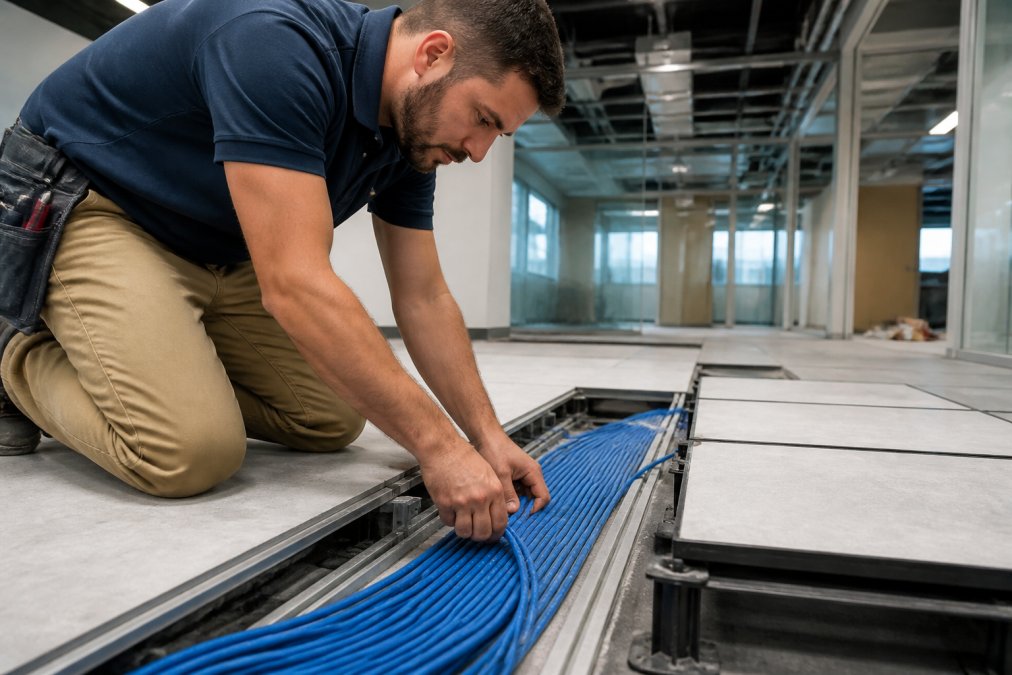
The physical layer covers everything you can touch: cable category and run limits, patch panel layout, rack elevations, power, grounding, and labeling. "Cat6A to all workstation drops" is a wish. "Cat6A, 90-meter permanent link maximum, terminated to keystone jacks, labeled SITE-FLOOR-DROP per TIA-606" is a standard — it names the category, the length limit, the termination, and the label format, so a certification test can pass or fail it. Don't invent this from scratch: TIA's published standards (TIA-568 for structured cabling, TIA-606 for labeling and administration) already define the floor. Adopt them, then add your site-type specifics on top. Our structured cabling scope runs on exactly that stack.
The logical layer covers what you can't touch: VLAN segmentation, IP address schema, routing, firewall rule base, wireless channel plan. Version-control these and tie them to site type.
Then close the interpretation gap with configuration templates. Define each device type's config once, store it in version control, apply it programmatically at provisioning, and run a compliance check afterward to confirm the applied config matches the template. The template becomes the documentation, and the documentation stays current by construction — the drift problem further down this page gets much smaller when the baseline is machine-readable.
One caution from the field: version templates by site type, not just by equipment model. A retail branch and a healthcare clinic don't share requirements, and one shared template quietly contaminates both.
Pre-deployment: survey, staging, credentials

Consistency is mostly won before anyone touches a cable. The pre-deployment phase exists to remove the conditions that force field improvisation — and field improvisation is where drift starts.
The site survey verifies the drawings against reality: floor plan accuracy, conduit and pathway condition, circuit capacity at the closet, environmental conditions, and who actually holds the key to the equipment room. Every mismatch found in survey is a line item. Every mismatch found on install day is a delay plus a change order.
Gear comes next, and gear logistics is where most programs leak money.
Credentials close out the phase. The cabling crew carries the certifications the spec requires — BICSI credentials on the cabling side, manufacturer credentials on the active gear — and every sub has a current COI on file before dispatch. We audit that in the Project Command Center rather than trusting a binder somewhere, because a lapsed COI discovered on a jobsite is a stop-work order.
Execution: the sequence is the standard
Execution is where the spec meets a building that didn't read it. The defense is a fixed work sequence, run identically at every site:
- Pathways first — conduit, tray, and J-hooks in before any cable is pulled
- Pull all horizontal runs before terminating any
- Terminate and label to the spec — labels on before testing, not after
- Certify every link and file the results by drop label
- Rack and power the network equipment
- Apply the configuration templates, then verify the applied config against the template
- Install and test physical security — cameras, readers, sensors — against the site security plan
The order matters. Crews that configure switches before the cable plant is certified end up reconfiguring after failed links surface. Crews that label after testing produce test reports that don't match the wall.
Post-deployment: validation, as-builts, handoff
Post-deployment validation is the most skipped phase and the most expensive one to skip. It's the gate that confirms what was built matches what was specified — and the record that makes the next ten years of service calls cheap.
Before a site is accepted, the packet holds:
- Certification results for every run, filed by drop label
- Rack elevations photographed
- Device configurations backed up to version control
- VLAN assignments verified against the logical standard
- Wireless heat map on file
- Every camera and every door tested
- As-builts updated with field modifications — not the design drawings, what was actually built
- Site acceptance form, signed
The as-built record is the baseline everything else compares against — troubleshooting, moves and changes, drift detection, eventual decommissioning. A site without accurate as-builts costs more on every single ticket, because every ticket starts with rediscovery instead of repair. If you inherited an estate without them, rebuilding the record is its own project — that's what network documentation services exists for.
Catch configuration drift before it compounds
Configuration drift is the gap between what a site runs today and what the baseline says it should run. It accumulates through manual changes, failed updates, undocumented fixes, and firmware versions that wander apart across the fleet. One unauthorized VLAN change at one site is a nuisance. The same habit across an estate is a security exposure with no owner.
NIST's guidance on security-focused configuration management (SP 800-128) treats monitoring as continuous, not periodic — and that matches what we see in the field. Quarterly manual audits find drift months after it lands, and by then the undocumented change has dependencies.
Detection needs three things:
- A documented baseline. The config templates and as-builts from the phases above. Without them there is nothing to compare against.
- Automated comparison of live device configs against that baseline, on a schedule — not when someone remembers.
- A remediation workflow that names who gets alerted, how fast, and whether the fix applies automatically or waits for review.
Split remediation by risk. Low-risk deviations — port descriptions, NTP servers, logging targets — re-apply automatically from the template. Routing changes and firewall rules get flagged for engineer review before correction, because auto-reverting a change someone made to keep a site alive at midnight causes the second outage. Either way, treat an undocumented change as an incident, not housekeeping. Programs that normalize small drift are scheduling a large remediation project for later.
Coordination is the product at 50 sites
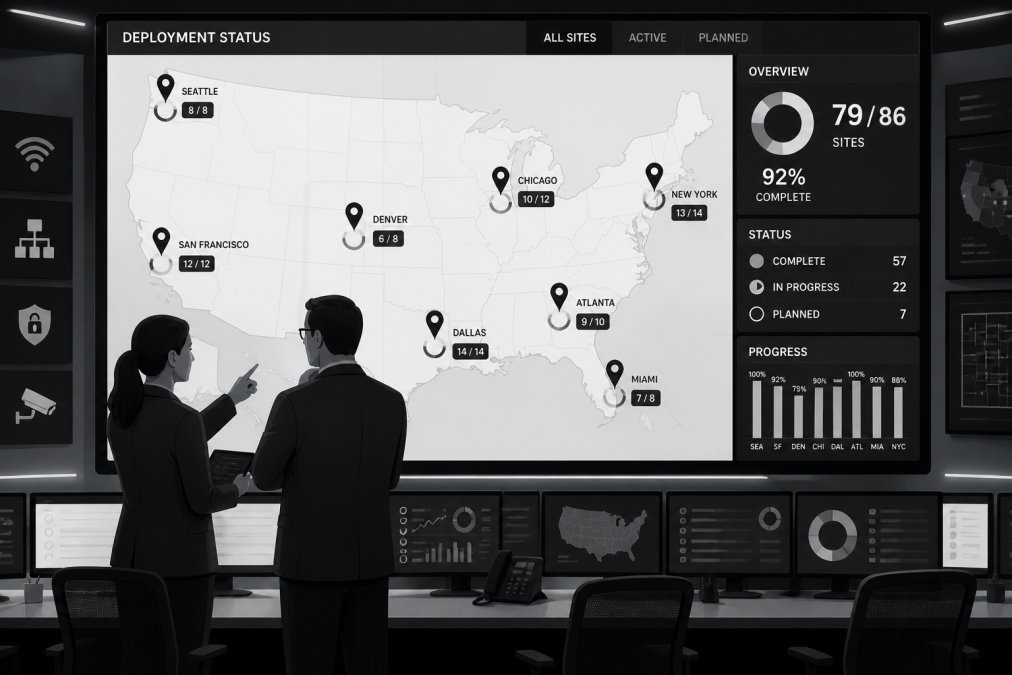
At ten sites, a spreadsheet and a weekly call work. At fifty, that model is already failing quietly. At two hundred, it has collapsed and everyone knows it. Consistent infrastructure buildouts at scale are a coordination product, not a craftsmanship product — the craft is table stakes, and the program lives or dies on visibility.
Centralized visibility means one place that shows every active site's phase, every validation gate passed or pending, every open punch item, and every post-handoff ticket. We run that through the Project Command Center — milestone signoff, sub dispatch, COI audit, and partner visibility in one portal — because chasing regional vendors for status by email is how deviations stay hidden until they're expensive.
Vendor governance is the other half. Fragmented regional contracting is the single most common source of inconsistency we get called in to fix: each vendor interprets the spec its own way, files documentation its own way, and answers to its own PM. The fix is either one nationwide deployment partner or a tightly governed vendor program — standardized onboarding, credential requirements, and documentation audits with teeth. What doesn't work is "send the spec and hope."
Compliance mapping belongs here too, before deployment rather than after. A clinic buildout carries HIPAA physical-safeguard requirements. A bank branch answers to its regulator. Some states add data protection obligations of their own. Map each requirement set to the site-type standard once, and every subsequent site inherits it.
Lifecycle and cost governance
A consistent estate stays consistent only if hardware ages on a plan. Most programs underinvest here — equipment runs past end-of-support because nobody can see fleet-wide age distribution, so replacement happens reactively, at emergency pricing, with downtime attached.
The governance loop is short:
- Procurement: standard SKUs per site type, volume pricing
- Deployment: serials, install dates, and warranty terms recorded at site acceptance — not "later"
- Active management: end-of-support dates and failure rates tracked in an annual fleet audit
- Refresh: budgeted 12–18 months ahead of end-of-life on a rolling forecast, so EOL notices are calendar items instead of surprises
- Decommissioning: documented data wipe and chain of custody. The EPA's electronics recycling guidance covers responsible disposal, and most enterprise compliance frameworks want the paper trail.
Track total cost of ownership by site type, not just initial project cost — per-site economics are what make budget conversations honest, and they're the frame we publish in multi-site IT deployment cost. When the refresh itself needs a program, that's network lifecycle management.
When SRS isn't the right fit
This framework assumes volume. If you run under 10 sites a year, hire local subs directly and keep the standard yourself in a shared document — our coordination overhead doesn't pay back until there's a pipeline of sites to spread it across.
Same answer if the whole estate sits in one metro and the real need is same-day onsite response: a local shop beats us on drive time, every time.
And if the gear genuinely changes per site — non-standard, client-supplied, different every deployment — the pre-staging model loses its advantage, and direct drop-ship with a good receiving contact is cheaper. The framework in this post still applies. We're just not the right fit to run it for you at that shape.
Straight answers
What IT directors and multi-site operators ask before standardizing a buildout program.
Network Deployment RFP Template: The Five-Layer Approach
If the buildout program starts with procurement, start here — the five-layer RFP structure that produces comparable bids and keeps the spec enforceable from the first vendor response, before a single site is built.
Make site 40 match site 1
If a multi-site buildout is on your calendar — new sites, a refresh, or an estate you inherited without documentation — email partners@srsnetworks.com with your site count, target geography, and whatever spec exists today. Cheryl returns scoping calls within one business day.
We deploy across the 48 contiguous states, Alaska, and Hawaii with in-house W-2 leads and a vetted W-9 subcontractor bench, pre-stage from West Coast and East Coast staging facilities, and give every partner live milestone visibility in the Project Command Center. NET 30 terms, 40/30/30 milestone billing on project work.
Randy Loveless is the CEO of SRS Networks, founded 1996. He has run multi-site deployment programs for 30 years — 900+ deployments and 10,000+ sites across the 48 contiguous states, Alaska, and Hawaii — and still reads site acceptance packets. SRS deploys as the field arm for MSPs, VARs, GCs, and national integrators that need consistent buildouts without building an in-house bench. Read more about SRS Networks.
Plan active deterrence across enterprise sites
Review the active deterrence planning pages for camera retrofits, field responsibilities, pilot acceptance and clearly labeled sample closeout records.