
How to Standardize Physical Security Across Locations
Physical security standardization fails for an operational reason, not a technical one: every site that picks its own vendor gets its own standard. The fix is three tools working together — a five-domain site assessment, a control library that names exact hardware, and a deployment process that enforces both. Here is how multi-site teams run that program without it rotting after the rollout.
On this page
- 01Why security standards drift across sites
- 02Score every site against the same five domains
- 03The control library is the actual standard
- 04Pilot three to five sites, then scale in waves
- 05Audits keep the standard from rotting
- 06Measuring whether the program worked
- 07When a standardization program is the wrong tool
- 08Straight answers
- 09Next step
Why security standards drift across sites
Most multi-site portfolios never decide to fragment their security infrastructure. It happens one site at a time. A branch opens, the regional manager calls the vendor they know, and the new site gets whatever that vendor sells. Ten years of that produces one portfolio with a legacy card-reader system at one branch, IP cameras from three manufacturers across a single region, and a site or two with no formal visitor management process at all.
SRS Networks has deployed physical security infrastructure and the network under it since 1996 — 900+ deployments and 10,000+ sites across the 48 contiguous states, Alaska, and Hawaii — and most of the standardization programs we field start exactly there: as cleanup. The trigger is rarely a break-in. It's an audit, an insurance renewal, or an incident where nobody could pull video from half the portfolio.
Standardizing takes three things running in parallel: one assessment methodology applied to every site, one control library that names approved hardware down to the model number, and a deployment process that enforces the standard instead of hoping regional contractors follow it. Miss any of the three and the rollout drifts.
Score every site against the same five domains
You cannot prioritize what you have not scored. A site assessment template puts every location on the same scale, so the remediation budget goes where the risk is — not where the loudest regional manager is.
Score five domains at every site: perimeter, entry and access control, interior surveillance, intrusion detection, and policy compliance. Use a 1-to-5 scale — 1 means no control in place, 5 means implemented, documented, and tested. Same criteria, same trained assessors, every site. The moment scoring criteria vary by region, the comparison is fiction.
Then weight each score by what the site holds. Inventory, cash handling, controlled substances, sensitive records, and server rooms carry different exposure. A 2.4 at a cash-heavy site outranks a 2.4 at a storage depot.
| Domain | Control present | Control effective | Score |
|---|---|---|---|
| Perimeter fencing and exterior lighting | Yes / No | Yes / Partial / No | 1–5 |
| Access control at every employee entrance | Yes / No | Yes / Partial / No | 1–5 |
| Camera coverage at entry and exit points | Yes / No | Yes / Partial / No | 1–5 |
| Intrusion detection and alarm monitoring | Yes / No | Yes / Partial / No | 1–5 |
| Visitor management process | Yes / No | Yes / Partial / No | 1–5 |
| Staff security training | Yes / No | Yes / Partial / No | 1–5 |
Sites averaging below 2.5 go to the front of the deployment queue. Sites above 4 usually need policy alignment, not hardware replacement — don't spend truck rolls where a documentation update closes the gap.
The control library is the actual standard
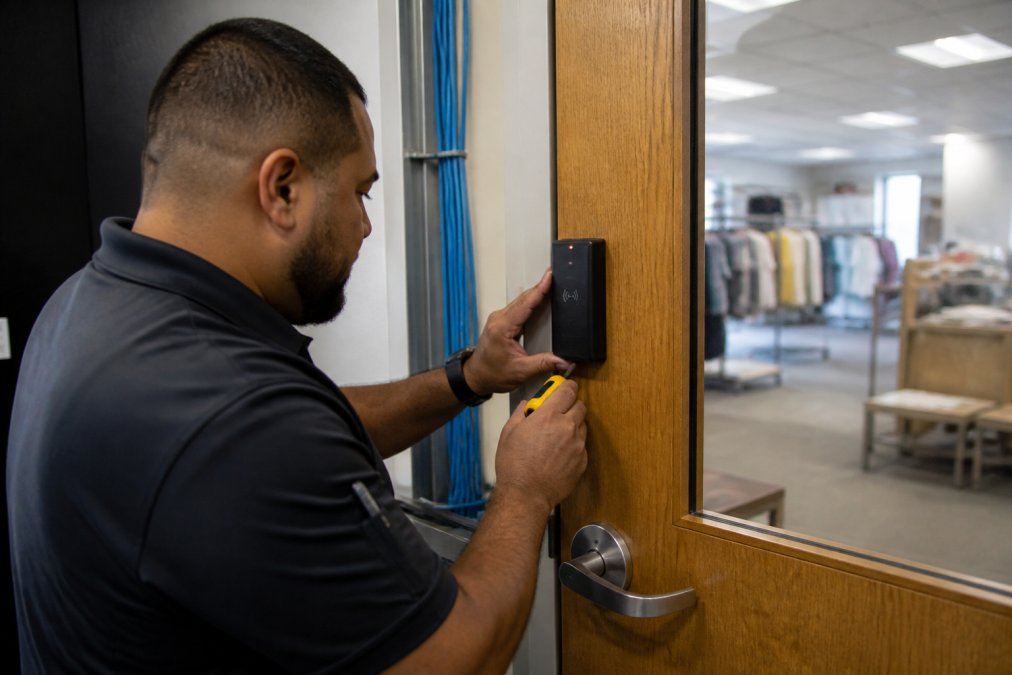
The control library is the master list of approved controls — and this is where most programs skip the step that matters. They define what is required ("card access at every employee entrance") but not which products implement it. A real control library names the access control panel, the reader and credential technology, the IP camera model and resolution, the NVR or VMS, the intrusion panel, and the cabling spec behind all of it — down to Cat6 and the termination standard.
Two decisions dominate the library. Credential technology: 125 kHz prox is cheap and trivially cloned, so pick smart card or mobile credential once, portfolio-wide. And management architecture: cloud-managed or on-premise, but one answer for the portfolio, not one per site. The security baseline is the minimum configuration derived from the library, and together they become the procurement standard — deviation requires a formal exception with a named approver, not a regional manager's preference.
The library only reaches the field as a commissioning checklist — a field-verifiable document a crew works through at every install:
- Site survey done; deviations from the standard floor plan documented before gear ships
- Hardware kit verified against the control library — model numbers, not categories
- Cabling pulled, terminated, and tested to the structured cabling spec, with labeled drops
- Readers mounted at standard height; locks tested fail-secure or fail-safe per site policy
- Camera placement matched to the coverage map — no blind entry or exit points; retention set per policy
- Alarm panel programmed; test signal confirmed by the monitoring station
- Photo documentation of installed hardware, terminations, and camera fields of view
- Site sign-off captured before the crew leaves
The photo requirement is not bureaucracy. Photographs of hardware, terminations, and camera views are the evidence trail that settles quality disputes and survives staff turnover. We run commissioning through the Project Command Center — every site's checklist, photos, and sign-off in one place — and tie 40/30/30 milestone billing to those signoffs, so nobody argues about whether a site is done.
Pilot three to five sites, then scale in waves

Rolling every site in one wave is how programs blow up. A phased roadmap controls scope, matches contractor capacity, and lets the standard get corrected before it scales.
Phase 1 is three to five pilot sites picked to represent the range of the portfolio — a high-volume site, a small branch, and the ugliest legacy building you own. The pilot validates four things: the approved hardware performs as spec'd in real conditions, the install spec has no gaps, the commissioning checklist survives contact with an actual crew, and install hours per site type get measured instead of guessed. Every correction lands in the control library before wave one ships.
Phase 2 scales in waves, ordered by risk score — worst-scored, highest-exposure sites first. That sequencing also builds the ROI story leadership sees: the riskiest sites show the biggest measurable improvement first.
Vendor consolidation is the strategic move inside Phase 2. A single accountable deployment partner replaces the web of regional contractors — one PO chain, one commissioning standard, one place to escalate. It also fixes the paperwork problem that stalls multi-vendor programs: we dispatch in-house W-2 techs and a vetted W-9 subcontractor bench, every sub with a COI verified before dispatch. Coordinating rollouts at that scale is its own trade — it's the same discipline we apply to multi-site network deployment programs.
Logistics decides more of the schedule than labor does. Drop-shipping gear straight to sites fails roughly 1 in 6 first deliveries — wrong address, locked dock, nobody authorized to sign. Pre-staging through a staging facility (we run one on each coast) configures, labels, and kits each site's hardware before it ships, and turns that 1-in-6 into under 1 in 50.
Audits keep the standard from rotting
Hardware standardization without operational standardization produces uniform equipment run inconsistently. Standard operating procedures carry the program: credential lifecycle (issue, modify, terminate — tied to HR events, not tribal memory), alarm response by event type, video review protocol for incident investigation, visitor and contractor access, maintenance schedules, and incident documentation.
Then audit against them. A unified framework only works when compliance is checked on a schedule and the results land in site performance metrics. Publish-and-pray is how standards rot.
The organizational half is harder than the technical half. Site managers lose vendor autonomy in this program, and some will fight it. Three things blunt the resistance: visible executive sponsorship (COO-backed programs get resourced; a "security department project" gets deprioritized), letting regional leaders nominate the pilot sites so they own the outcome, and training site staff before go-live — staff who meet a new system cold invent workarounds that break the standard in week one.
Measuring whether the program worked
Define "better" before the program starts, or the post-deployment argument never ends. Three measurable buckets: operational efficiency (administrative hours per site, procurement overhead, spare-parts inventory), incident reduction (unauthorized-access attempts, alarm activations, theft — before vs. after), and compliance cost (audit preparation time and findings per site).
| Metric | Baseline | Target | Measure at |
|---|---|---|---|
| Audit preparation time per site | Record before wave one | Cut by a defined % | 6 months post-deployment |
| Security incidents per site per quarter | Record before wave one | Cut by a defined % | 6 months post-deployment |
| Contractor-management hours per month | Record before wave one | Cut by a defined % | 6 months post-deployment |
| Time to resolve credential issues | Record before wave one | A defined hour count | 6 months post-deployment |
| Sites meeting the security baseline | Record before wave one | 100% | Program close |
Notice none of those rows need an industry statistic. Record your own baseline before wave one and the program's math is your own — which is the only version leadership will trust at renewal time.
When a standardization program is the wrong tool
A standardization program is real overhead — assessment labor, exception governance, commissioning discipline. Three cases where it's the wrong tool, and where SRS is the wrong fit for the work.
Under roughly 10 sites in one metro. Hire a local security integrator directly and skip the program overhead. Our coordination model doesn't pay back at that scale, and a local shop beats us on drive time for service calls.
A genuinely heterogeneous portfolio. If every site is a different building type with a different use — say, a mixed bag of acquisitions you plan to divest — standardize policy and monitoring, not hardware. A rigid control library fights that reality and loses.
A single-site upgrade. One site's camera refresh doesn't need a control library or a phased roadmap. Get three local quotes and move.
Straight answers
What facilities, security, and IT directors ask before standardizing a multi-site portfolio.
How to Write a Structured Cabling RFP That Gets Comparable Bids
The cabling layer under every reader and camera deserves its own spec. This companion piece covers the 10-section RFP architecture that gets comparable bids on the cable plant — the same discipline this article applies to the security stack above it.
Put one standard on every site
If you're scoping a standardization program, start with the current state: how many sites, how many vendors, what breaks most. Email partners@srsnetworks.com with your site count and target geography — Cheryl returns scoping calls within one business day.
We deploy access control, surveillance, and the cabling under both across the 48 contiguous states, Alaska, and Hawaii — one commissioning standard in the Project Command Center, 40/30/30 milestone billing, NET 30 terms.
Randy Loveless is the CEO of SRS Networks, founded 1996. He has run multi-site security and network deployments for 30 years — 900+ deployments and 10,000+ sites across the 48 contiguous states, Alaska, and Hawaii, delivered from 6 offices in 4 states with West Coast and East Coast staging facilities. SRS deploys as the accountable field partner for enterprises, MSPs, and integrators that need one standard held at every site. Read more about SRS Networks.
Plan active deterrence across enterprise sites
Review the active deterrence planning pages for camera retrofits, field responsibilities, pilot acceptance and clearly labeled sample closeout records.